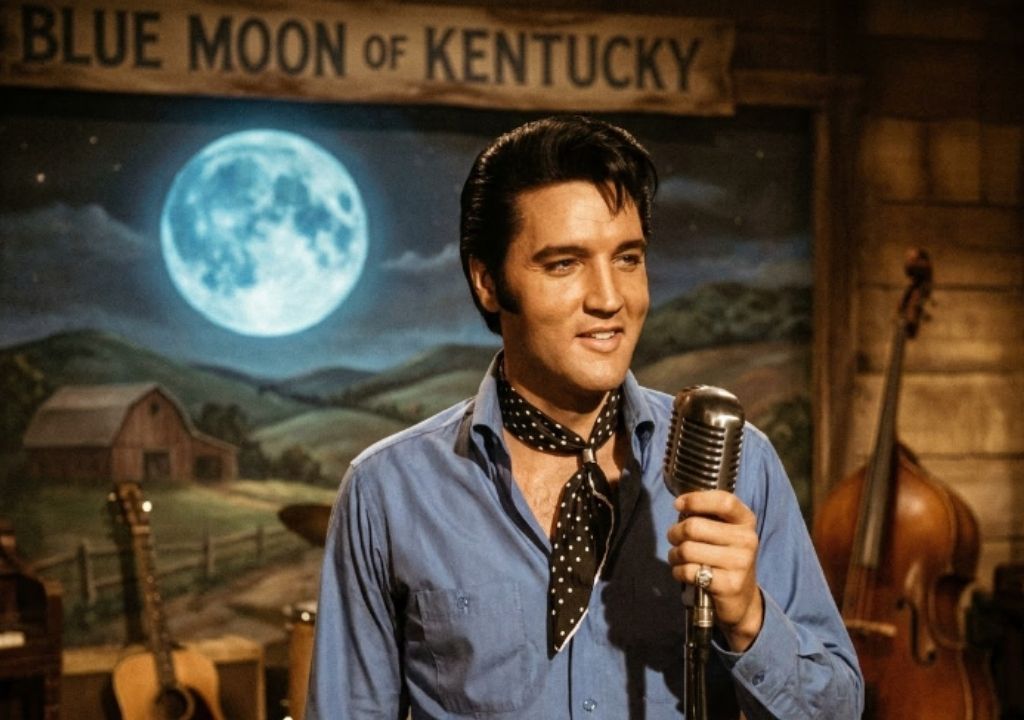
Introduction
In July 1954, immediately following the historical lightning bolt of “That’s All Right,” nineteen-year-old Elvis Presley and his bandmates—guitarist Scotty Moore and double bassist Bill Black—found themselves needing a companion track for their debut Sun Records single. Inside the intimate, heat-soaked confines of Sun Studio at 706 Union Avenue in Memphis, Tennessee, producer Sam Phillips suggested taking a look at a familiar country classic. What happened next was nothing short of a musical alchemy that reshaped the landscape of American popular culture forever. That song was “Blue Moon of Kentucky.”
Originally penned and recorded in 1946 by the undisputed “Father of Bluegrass,” Bill Monroe, “Blue Moon of Kentucky” was born as a mournful, solemn waltz in 3/4 time. It was a weeping acoustic masterpiece about heartbreak and longing under a dark Southern sky. Yet, when Elvis picked up his Martin acoustic guitar and began strumming, he instinctively broke away from the traditional bluegrass mold. With a mischievous grin and an electric pulse of youthful energy, Elvis transformed the slow waltz into a blistering, uptempo 4/4 rockabilly powerhouse.
The transformation was revolutionary. Bill Black slapped his stand-up bass with a rhythmic snapping drive that replaced the need for a traditional drum kit, while Scotty Moore tore through sharp, blues-drenched guitar runs that crackled with spontaneous excitement. Over top of this infectious sonic engine, Elvis delivered a vocal performance brimming with sheer joy, playful vocal hiccups, and an effortless swagger that defied categorization. Sam Phillips captured the magic with his famous slapback echo, creating a reverberating texture that felt like a warm summer breeze blowing off the Mississippi River.
When the single was released on July 19, 1954, with “That’s All Right” on the A-side and “Blue Moon of Kentucky” on the B-side, it announced to the world that a brand-new genre had arrived. In a legendary show of mutual respect, Bill Monroe himself was so impressed by Elvis’s audacious reimagining that he later altered his own stage arrangement of the song, starting it as a slow waltz before kicking into Elvis’s fast rockabilly tempo.
Beyond its technical brilliant innovation, what gives the track its enduring charm is the unadulterated human warmth caught on tape. You can almost feel the humid Southern evening air outside Sun Studio and hear the hum of vacuum tubes glowing in the control room. It was not a product of slick commercial calculation, but of three young men playing pure, heartfelt music together because they simply couldn’t help themselves.
Decades later, “Blue Moon of Kentucky” remains a glowing gem of early rock ‘n’ roll history. It stands as a vibrant bridge connecting traditional hillbilly country, rural blues, and the electric dawn of modern pop culture. Listening to this classic recording on a spinning vinyl record or through the warm glow of a vintage radio instantly transports us back to a simpler time—a mid-century world of neon-lit diners, open highways, and a young truck driver who dared to turn a sad bluegrass waltz into an eternal anthem of wild freedom.