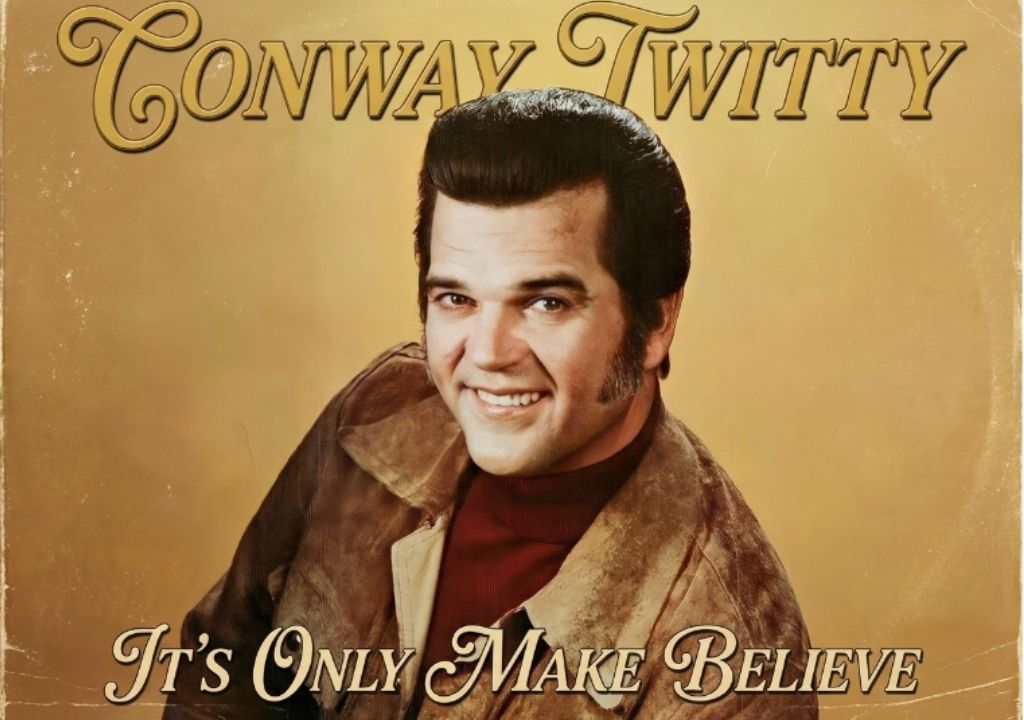
Introduction
There is a distinct, beautiful ache that belongs entirely to the era of late-1950s vinyl. It was a time when popular music was caught in a thrilling, transitional space—no longer just traditional big band or country, but not yet fully consumed by the polished pop formulas of the decades that followed. When you listen to a song from this era, you can practically feel the heavy hum of vacuum-tube amplifiers and the warm crackle of the needle navigating the grooved wax. In the autumn of 1958, a song arrived on the airwaves that perfectly captured this emotional weight, blurring the boundaries between early rock ‘n’ roll, dramatic pop, and heartfelt country. That song was “It’s Only Make Believe,” and the man behind that unforgettable, earth-shaking voice was Harold Jenkins, whom the world would come to know and revere as Conway Twitty.
To truly understand the impact of “It’s Only Make Believe,” one must understand the sheer vocal power required to deliver it. Long before Conway Twitty became an absolute titan of traditional country music in the 1970s and 1980s, he was a young man deeply inspired by the raw energy of rockabilly and the smooth, emotional delivery of rhythm and blues. Co-written by Twitty and Jack Nance while sitting in a hotel room in Hamilton, Ontario, the song was never intended to be a quiet background melody. It was designed to be a grand, operatic confession of unrequited love and absolute vulnerability. The premise is devastatingly simple yet universally resonant: a man hopelessly in love with someone who only sees him as a friend, forcing him to live in a painful fantasy world where his feelings are mutual.
The musical arrangement builds like a gathering storm. It begins deceptively quiet, carried by a steady, rhythmic acoustic guitar strum and a subtle, walking bassline that anchors the melody. But as the song progresses, the tension mounts, mirroring the rising desperation of the lyrics. When Conway reaches the bridge, the restraint completely shatters. His voice transitions from a smooth, velvety croon into a fierce, gravelly, passionate growl that pushes the boundaries of the audio equipment of the time. The emotional crescendo where he holds the high notes is nothing short of breathtaking. It is a performance filled with such raw, unadulterated conviction that listeners in 1958 famously mistook the track for a new release by Elvis Presley. Yet, Conway possessed a unique bluesy depth and a sincerity that was entirely his own.
“It’s Only Make Believe” did not just top the charts; it became a definitive anthem for anyone who has ever loved someone from afar. It proved that a pop or rock ballad could hold the emotional weight of a classic tragedy. Decades later, the track hasn’t lost a single ounce of its original, heart-wrenching power. It stands as a timeless monument to the art of vocal storytelling, reminding us of an era when music was defined by the sheer scale of human emotion and the unforgettable soul of a true legend.