Introduction
There is a specific, crackling electricity that belongs entirely to the late 1950s and early 1960s—a time when the musical landscape of Great Britain was undergoing a seismic, irrevocable shift. Before the world-conquering phenomenon of the Beatles, and before the gritty blues-rock explosion of the Rolling Stones, a young man from Lucknow, India, named Harry Webb stepped onto a British stage and changed everything. Rechristened as Cliff Richard, he brought a dangerous, pulsating energy to a country that was still recovering from the gray, austere aftereffects of wartime rationing. Together with his legendary backing band, The Shadows, Cliff Richard provided the definitive spark that ignited the British rock and roll revolution. And at the absolute center of that explosive firestorm was a single, historic track: “Move It.”
To truly understand the impact of “Move It,” one must journey back to a time when British youth were desperately searching for a voice of their own. American imports like Elvis Presley, Buddy Holly, and Little Richard had already crossed the Atlantic, sending shockwaves through the hearts of teenagers who huddled around their valve radios, listening to the distant, static-heavy broadcasts of Radio Luxembourg. Yet, domestic British music was still dominated by polite crooners, novelty acts, and traditional jazz. The homegrown rock scene was largely seen as a pale, theatrical imitation of American greatness. That all evaporated in August 1958 when “Move It” was unleashed upon the public. Written by Ian Samwell in the back of a London bus, the song was raw, driving, and entirely authentic. John Lennon would later famously remark that before “Move It,” there had been nothing worth listening to in British music. It was the moment British rock and roll grew up and claimed its own identity.
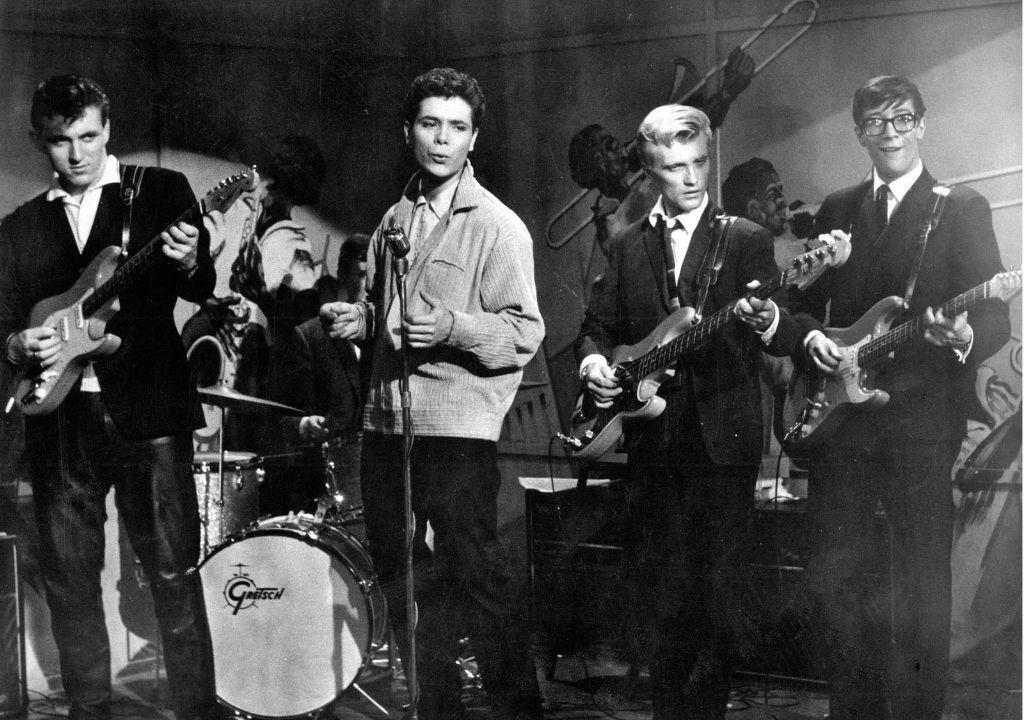
This particular performance from The Cliff Richard Show, broadcast on March 19, 1960, captures a pivotal moment in cultural history. By early 1960, Cliff Richard and The Shadows had refined their act into a slick, sophisticated, yet undeniably potent powerhouse. Looking at the footage, the visual contrast is striking. Dressed in sharp, tailored suits, they present an image of clean-cut professionalism, yet the moment the music starts, the underlying rebellion is palpable. Cliff Richard commands the stage with an effortless, brooding charisma, his vocal delivery sharp, rhythmic, and dripping with an innate coolness that perfectly mirrored the restlessness of his generation. Behind him, The Shadows operate with a symbiotic precision that would set the gold standard for every guitar band that followed. Hank Marvin’s iconic, clean, echoing guitar tone—driven by his famous Fiesta Red Fender Stratocaster—cuts through the air like a knife, providing the melodic backbone that defined the era’s sonic landscape, complemented perfectly by Bruce Welch’s steady rhythm guitar, Jet Harris’s driving bass, and Tony Meehan’s crisp, propulsive drumming.
What makes “Move It” stand the test of time is its brilliant simplicity and its unadulterated passion. It is a song stripped of all pretense—just pure, unfiltered rhythm, a soaring vocal melody, and a driving beat that demands you to move. It encapsulates the sheer optimism and the thrilling, terrifying freedom of youth in a rapidly evolving world. For those who lived through that golden era, watching this 1960 performance is like stepping into a time machine, instantly evoking memories of smoky dance halls, jukeboxes glowing in corner cafes, and the sweet, intoxicating scent of Brylcreem and teenage rebellion. It remains a monument to the dawn of a new cultural epoch, a timeless reminder of the day that British rock and roll finally found its soul and shook the world to its very foundations.