INTRODUCTION
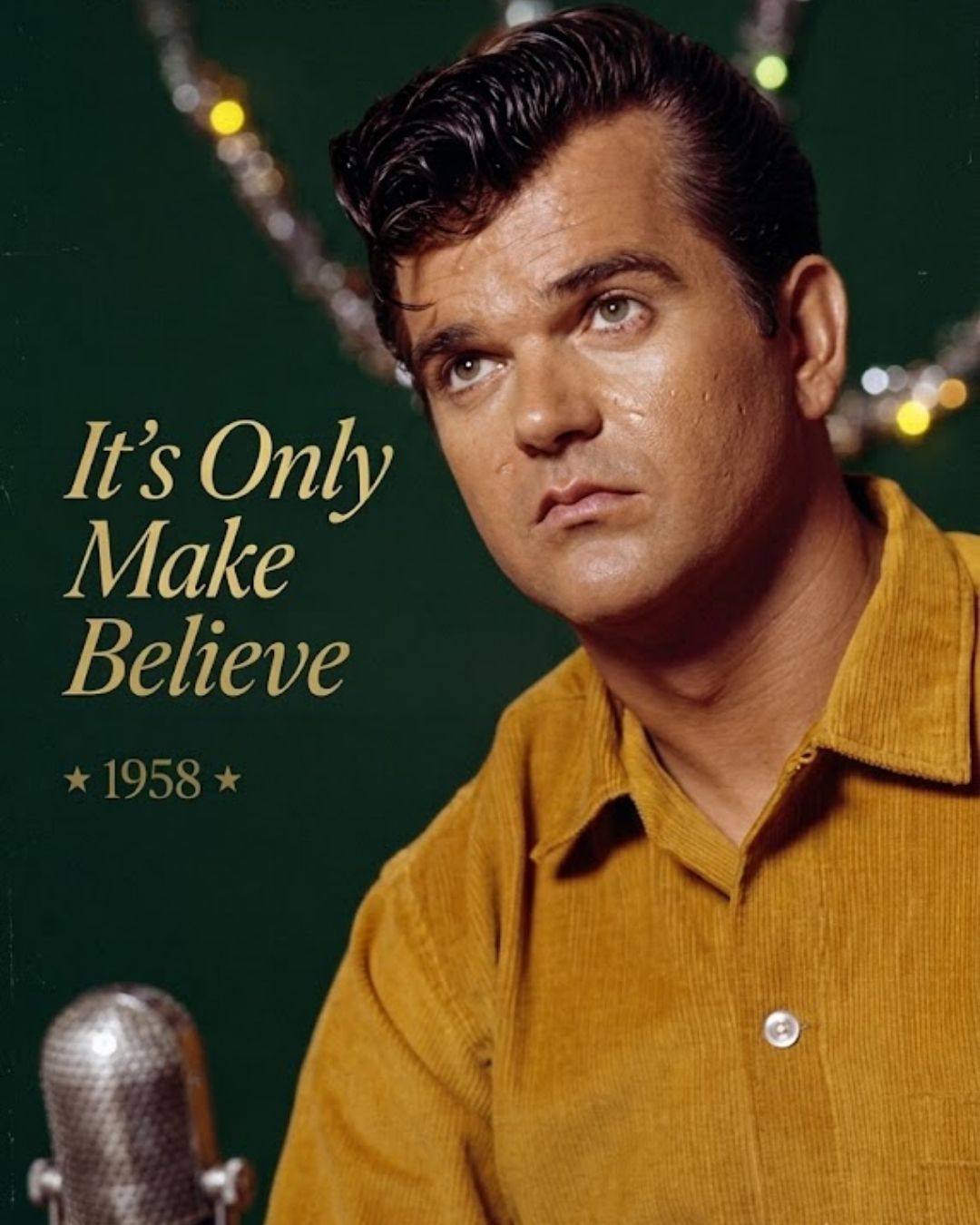
In May 1958, inside Nashville’s Bradley Studios, a young rockabilly singer named Harold Jenkins stepped up to the microphone, defeated and ready to abandon music for farming. Instead, he unleashed a volcanic, passionate gospel vocal that sent chills through the control room. How did an accidental masterpiece hidden on a vinyl flipside become a defining pop anthem?
THE DETAILED STORY
Before he became an untouchable country music titan with dozens of chart-topping hits, Harold Lloyd Jenkins was a struggling rockabilly hopeful fighting for survival under his newly minted stage name, Conway Twitty. In early 1958, while grinding through an exhausting tour across Ontario, Canada, Twitty and his drummer Jack Nance retreated between sets at the Flamingo Lounge in Hamilton. Armed with raw heartbreak and twenty fleeting minutes, they hammered out a sorrowful ballad titled “It’s Only Make Believe”.
On May 7, 1958, Twitty entered Bradley Studios in Nashville under the guidance of MGM producer Jim Vienneau. Surrounded by legendary session players including pianist Floyd Cramer, guitarist Grady Martin, bassist Floyd Chance, and iconic backing vocalists The Jordanaires, Twitty stepped to the microphone. Vienneau urged him to abandon polite pop restraint and lean directly into the gravelly, primal growl lurking in his throat. Built upon a slow, hypnotic triplet rhythm, the song became a masterclass in dynamic tension, opening as a hushed, trembling confession of unrequited love before swelling relentlessly into an earth-shattering operatic crescendo.
Yet commercial fate initially seemed indifferent. MGM Records relegated the track to the B-side of an upbeat single titled “I’ll Try” in July 1958. When the record failed to gain traction, a despondent Twitty assumed his career was finished, returning home to Helena, Arkansas, to work the family farm. Salvation arrived unexpectedly from Columbus, Ohio, where a curious radio disc jockey flipped the vinyl to see what was hidden underneath.
The listener reaction was instantaneous and hysterical. Because The Jordanaires supplied their signature celestial harmonies and Twitty commanded such a dramatic, brooding baritone, thousands of listeners convinced themselves that Elvis Presley was recording under a secret alias. The feverish mystery ignited radio stations nationwide. The single skyrocketed up the charts, seizing the No. 1 spot on the Billboard Hot 100 on November 10, 1958, and conquering the UK Singles Chart shortly thereafter.
“It’s Only Make Believe” remained the only pop chart-topper of Conway Twitty’s career, but its artistic legacy was monumental. Though he would later transition to country music and amass over forty Number One hits, this 1958 masterpiece proved that raw vulnerability could roar with operatic force, permanently redefining the emotional power of the rock ballad.