INTRODUCTION
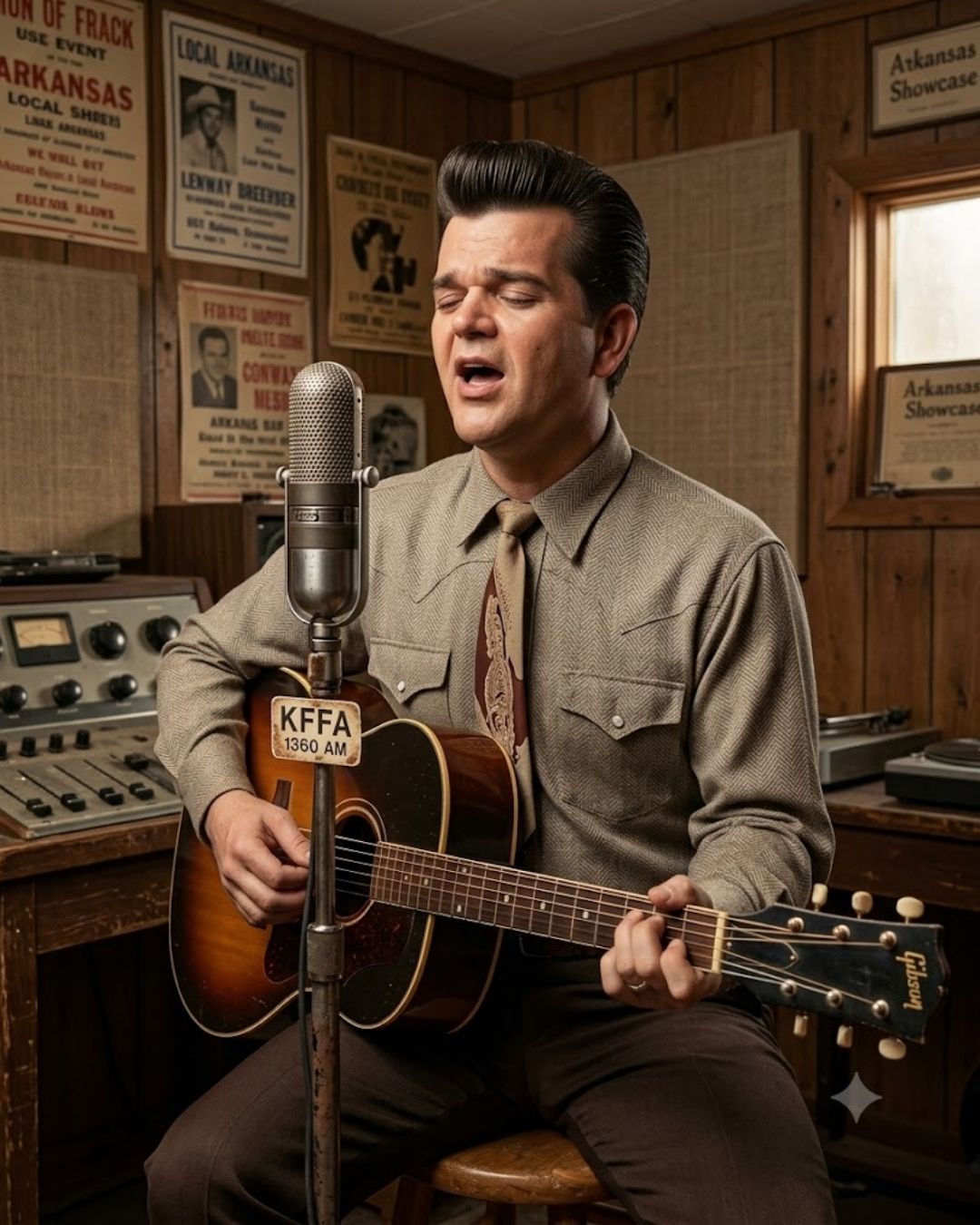
Every Saturday morning in the Mississippi River port of Helena, Arkansas, a ten-year-old boy named Harold Jenkins climbed the stairs to the second-floor studio of KFFA. Clutching a Sears Roebuck acoustic guitar that looked oversized in his small hands, the quiet son of a ferryboat pilot stepped up to the massive studio microphone. Years before the world would know him as Conway Twitty, the future Country Music Hall of Famer commanded a thirty-minute live program that captivated local riverboat workers, sharecroppers, and families across the Delta. What drove a radio station in the mid-1940s to hand over valuable airtime to an elementary schooler with nothing more than raw instinct and a guitar?
THE DETAILED STORY
Founded in 1941, KFFA was already a cultural crucible, broadcasting the groundbreaking blues sounds of King Biscuit Time across the Arkansas-Mississippi Delta. Yet station management recognized something extraordinary in Harold Jenkins. Taught basic chords by his father and a local neighbor, young Jenkins possessed pitch-perfect vocal clarity and an instinct for phrasing far beyond his years. After a short informal audition, station directors offered the boy his own Saturday morning showcase, broadcasting country ballads, western swing, and gospel numbers live across Phillips County.
The live setting provided no safety net. With no magnetic tape for retakes or studio polish, Jenkins performed directly into the transmitter, learning to regulate his breath, gauge acoustic dynamics, and hold the rapt attention of a diverse working-class audience. Accompanied occasionally by childhood friends who formed his first backing group, the Phillips County Ramblers, the boy turned KFFA into a masterclass in professional performance. The weekly broadcast quickly became an essential Saturday ritual for regional listeners, cementing Jenkins’ reputation as a prodigy.
This formative immersion fundamentally defined the trajectory of his career. Long before adopting the stage moniker Conway Twitty in 1957, recording at Sun Studio, or scoring a record-shattering 55 number-one country singles, Harold Jenkins learned the art of musical storytelling in the red-brick studios of Helena. The intimate, conversational baritone that later made hits like “Hello Darlin'” iconic was not an accidental studio discovery; it was honed before an open microphone on KFFA, where a ten-year-old learned how to speak directly to the listener’s heart.
Ultimately, Jenkins’ Saturday broadcasts at KFFA reflect the authentic roots of American popular music, where local radio served as the premier proving ground for natural genius. The poise and discipline acquired over those Helena airwaves transformed a small-town ferryman’s son into one of the most enduring vocal architects in country music history.