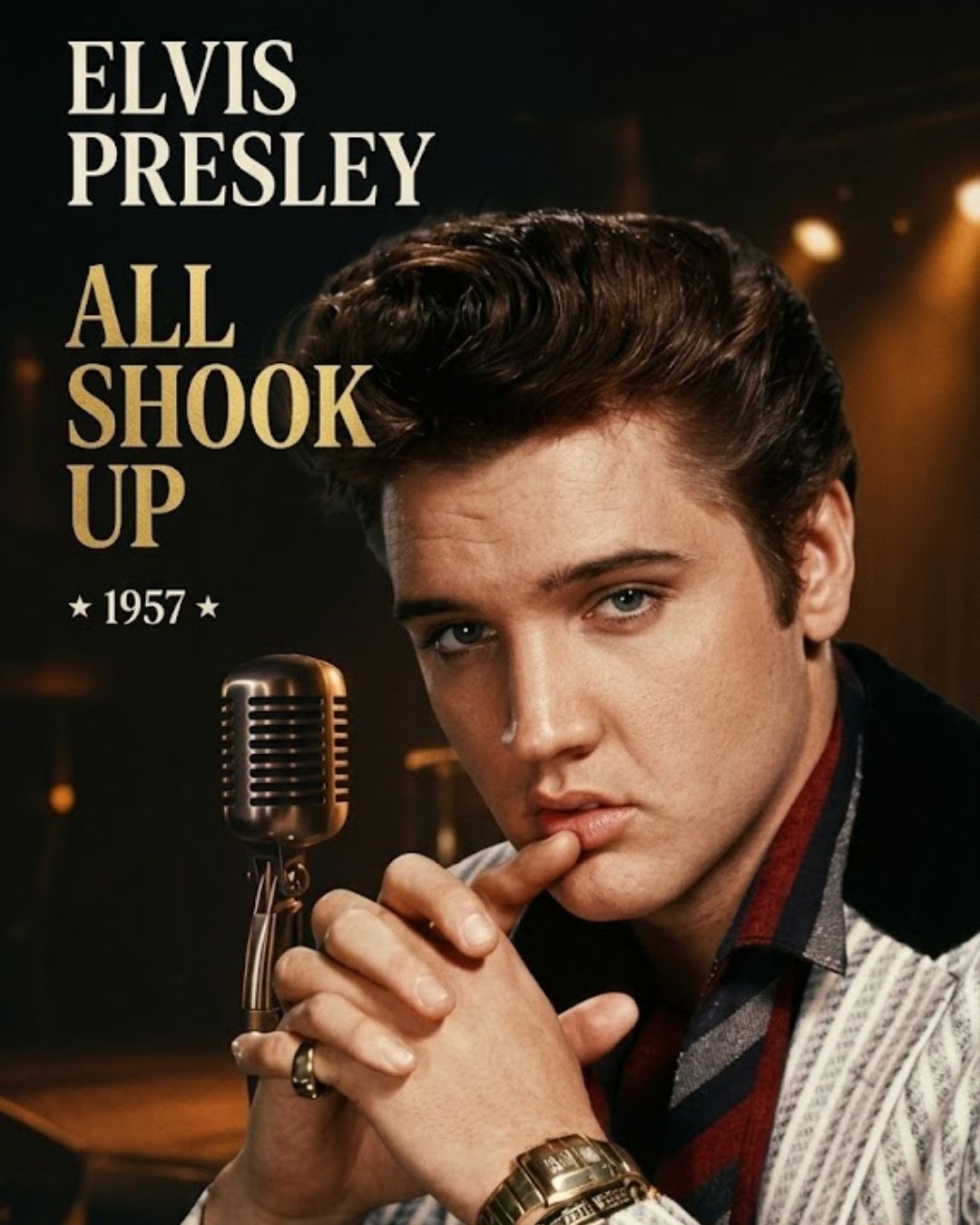
INTRODUCTION
On January 12, 1957, inside the walls of Radio Recorders in Hollywood, Elvis Presley stood before the microphone without sheet music, searching for an elusive percussive pulse. Tapping frantically on the varnished back of his Martin acoustic guitar, he unlocked a groove that would electrify millions. How did an accidental rhythm and an offhand challenge ignite the definitive rock and roll sensation of that golden era?
THE DETAILED STORY
The genesis of the track traces back to late 1956 inside the Manhattan offices of Shalimar Music. Co-owner Al Stanton playfully shook a bottle of Pepsi-Cola, turned to prolific Brooklyn-born songwriter Otis Blackwell, and dared him to compose a hit around the phrase “all shook up.” Blackwell, possessing an innate genius for syncopated rhythm and blues hooks, penned the song within days. When the demo reached Elvis Presley, the young singer instantly recognized its raw kinetic potential and made it his own.
On January 12, 1957, Presley gathered his trusted ensemble at Radio Recorders in Hollywood. The studio atmosphere was intensely focused. Alongside guitarist Scotty Moore, bassist Bill Black, drummer D.J. Fontana, pianist Hoyt Hawkins, and vocal quartet The Jordanaires, Elvis was determined to strip away excessive polish in favor of visceral swing. During the session, Elvis struggled to achieve the precise rhythmic punctuation he envisioned through traditional instruments alone. In a stroke of spontaneous ingenuity, he unslung his Martin acoustic guitar and began slapping its wooden back with his hands and ring. Fontana complemented this makeshift percussion by clicking his drumsticks together, generating a crisp, galloping shuffle that anchored the entire arrangement.
Presley channeled genuine vulnerability through his vocal delivery, stuttering his syllables and bending notes to evoke the dizzying euphoria of romantic infatuation. His playful vocal hiccups, breathy phrasing, and sudden dynamic leaps transformed Blackwell’s lyrics into an anthem of youthful surrender. Over the course of ten rigorous takes, the musicians refined every accent until the groove clicked with absolute, effortless perfection.
Issued by RCA Victor in March 1957, the single erupted into a transatlantic phenomenon. It conquered the Billboard Top 100 for eight consecutive weeks, quickly selling over two million copies domestically. In an extraordinary demonstration of stylistic crossover, the record achieved a historic triple crown by simultaneously dominating the national Pop, Rhythm and Blues, and Country charts. Furthermore, it secured Elvis his very first official number-one single in the United Kingdom, shattering international broadcast barriers and establishing rock and roll as a permanent global language. Decades later, its infectious simplicity and pioneering production remain a timeless benchmark of twentieth-century American musical art.