INTRODUCTION
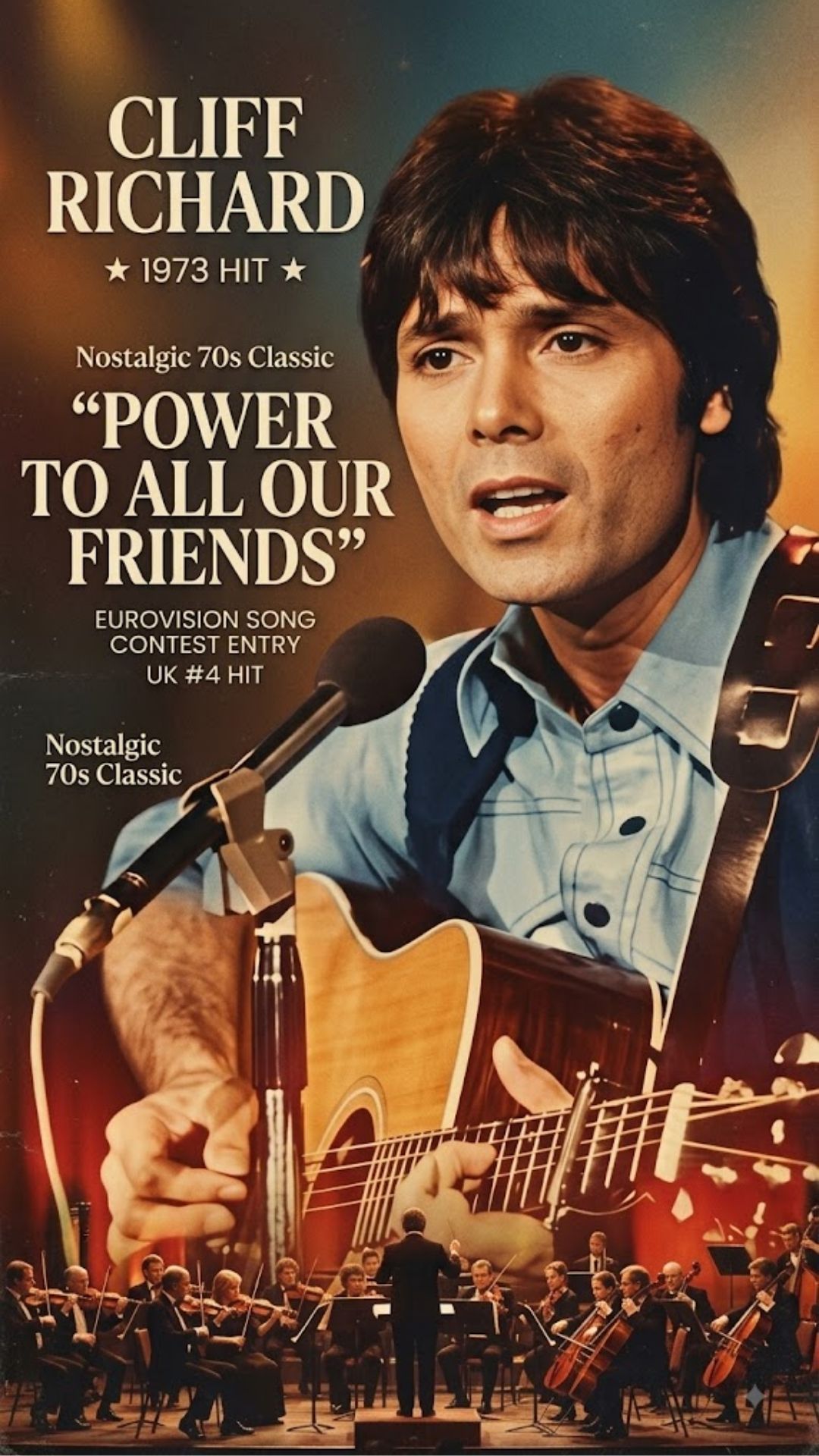
On the evening of April 7, 1973, inside Luxembourg’s Nouveau Théâtre, over three hundred million television viewers watched British icon Cliff Richard step back onto the Eurovision stage. Carrying the weight of his famous 1968 runner-up finish, he delivered a soaring pop performance. How did this joyful harmony transcend competitive scoring to become an international standard of solidarity?
THE DETAILED STORY
Written by the seasoned British songwriting duo Guy Fletcher and Doug Flett, the track was conceived during an era marked by countercultural movements, social demonstrations, and calls for worldwide fellowship. The composition cleverly blended the infectious drive of early 1970s pop-rock with upbeat orchestral brass, handclaps, and an unmistakable call-and-response refrain. Chosen decisively by British television audiences on the BBC show Cilla through a postal vote, the song was chosen to represent the nation at the Eurovision Song Contest 1973. Produced by David McKay at London’s famed EMI Studios, the recording harnessed Richard’s effortless vocal warmth, dynamic charisma, and unmistakable rhythmic precision.
When Cliff Richard arrived in Luxembourg on April 7, 1973, anticipation across the United Kingdom was immense. Having famously lost the 1968 contest by a single point with “Congratulations,” audiences viewed this performance as his rightful coronation. Under intense security and international television scrutiny, Richard delivered a radiant, energetic rendition backed by lush orchestral arrangements. Although Luxembourg captured first place in a historically close voting showdown, the British entry secured third place with 123 points. However, commercial reality quickly proved that contest rankings could never limit the reach of a truly timeless melody.
Released internationally on March 9, 1973, the single sparked a massive commercial resurgence for the artist. In the United Kingdom, it soared to number four on the Official Singles Chart, marking his highest-charting record in several years. Across mainland Europe and global territories, it became a runaway sensation, reaching number one across multiple national charts including the Netherlands, Norway, Sweden, and Malaysia. Richard even recorded multiple foreign-language versions, cementing its status as an international phenomenon that ultimately generated over one million global sales.
Decades later, the anthem retains its status as a masterclass in optimistic pop songwriting. Rather than fading into competition trivia, the track remains an essential celebration of community and artistic resilience. Through its uplifting arrangement and Richard’s enduring spirit, it stands as a brilliant testament to the unifying power of mid-century pop music.