Introduction
There is a precise kind of melancholy that belongs exclusively to the late 1970s—a moment when smooth analog studio craftsmanship met the crisp, rhythmic dawn of the synth-pop revolution. Few records capture that bittersweet inflection point as effortlessly as Cliff Richard’s 1979 masterpiece, “We Don’t Talk Anymore.” Written and produced by Alan Tarney, the track did not merely top charts across the globe; it revitalized the career of a British pop icon who had already spent two decades in the spotlight, proving that true artistry evolves without losing its soul.
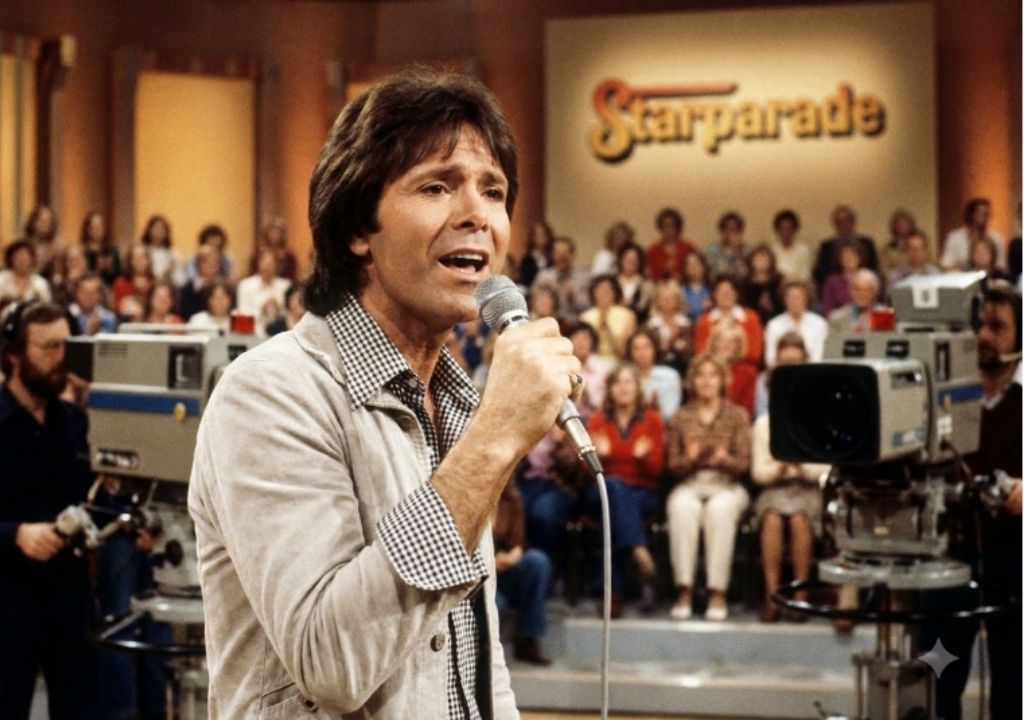
When Cliff Richard took the stage on the West German television show Starparade on October 11, 1979, audiences witnessed a masterclass in understated emotional delivery. Dressed in the stylish, relaxed aesthetic of the era, Richard moved with a gentle confidence. He did not need grand theatrical gestures to convey the song’s heartache. Instead, his smooth vocal technique, pristine breath control, and warm timbre carried the heavy weight of unspoken words. The contrast between the track’s upbeat, danceable tempo and its deeply sorrowful lyricism created an irresistible tension that defined the late-seventies pop landscape.
At its core, “We Don’t Talk Anymore” explores the quiet tragedy of modern emotional distance. Unlike traditional break-up anthems filled with fiery arguments or dramatic weeping, this song deals with the subtle, insidious decay of communication. Two people who once shared their deepest secrets gradually drift into total radio silence. The narrative reflects that lingering post-breakup phase where love has not necessarily turned into hatred, but rather into an awkward, painful indifference. You see the person carrying on with their life, hearing whispers of their new endeavors through mutual acquaintances, while you remain frozen in memories of what used to be.
Musically, the song was a marvel of late-70s pop production. Alan Tarney crafted a brilliant rhythm bed driven by a steady, pulse-like bassline, shimmering synthesizer chords, and crisp electric guitar riffs. The arrangement feels light on its feet, almost buoyant, yet the driving tempo mirrors the restless mind of someone trying to dance away their sorrow. Cliff Richard’s vocal performance balances crisp pop precision with authentic vulnerable resonance. Every phrase lands with flawless rhythm, yet carries an unmistakable ache in the lower register.
For those of us who lived through that golden era of broadcasting, watching performances like the one on Starparade brings back a flood of nostalgia. It reminds us of a time when pop music possessed an enduring warmth, crafted by hand in legendary studios and performed live with genuine charisma. Decades later, “We Don’t Talk Anymore” remains a timeless anthem for anyone who has ever stared at a silent telephone, wondering how two souls who once meant everything to each other could end up as complete strangers.