INTRODUCTION
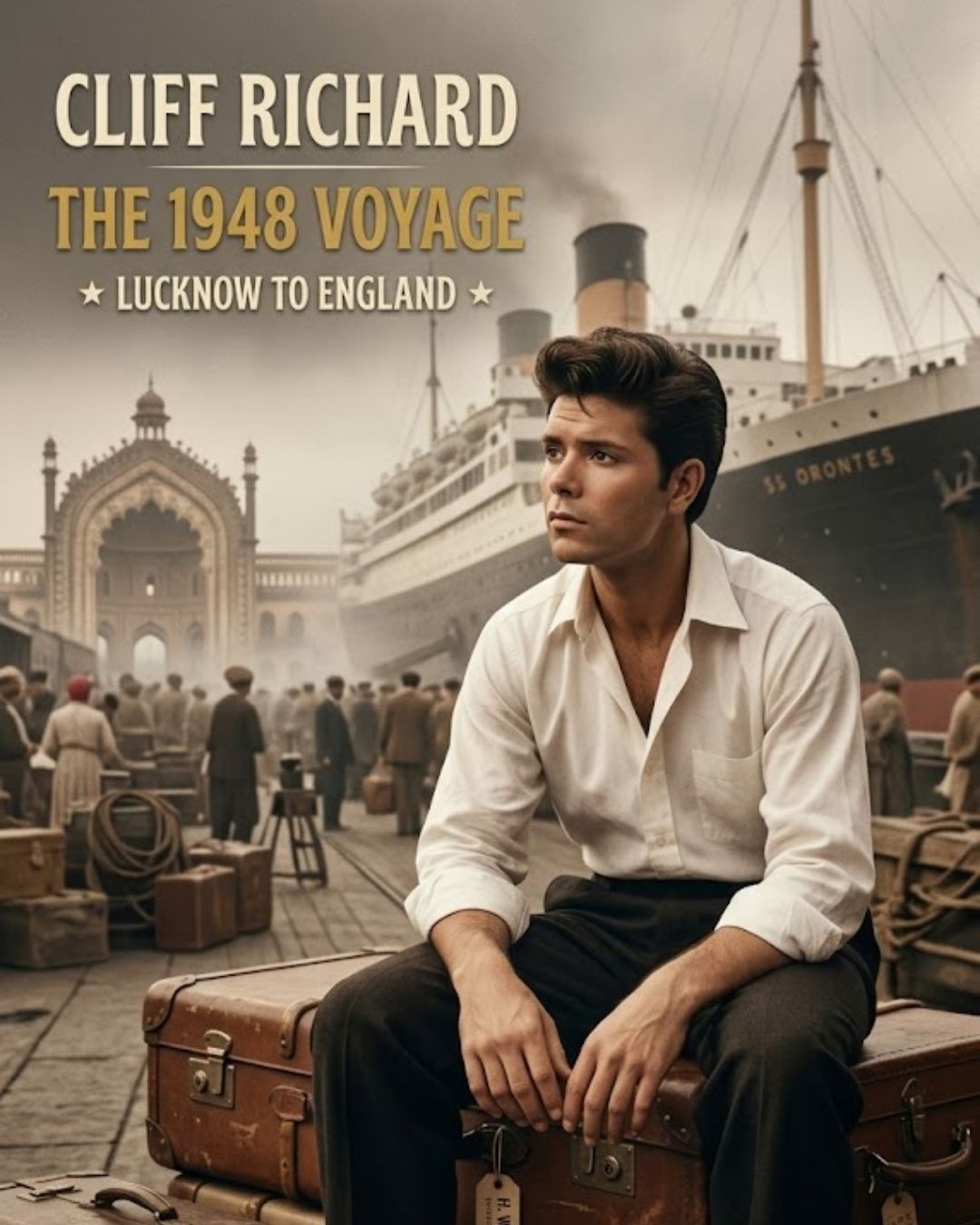
On a sweltering morning in 1948, an eight-year-old boy named Harry Rodger Webb stood on the deck of the passenger liner SS Ranchi, watching the coastline of the Indian subcontinent fade into the horizon. Born in Lucknow in 1940, the child had known only the vibrant sights, lush greenery, and complex socio-political climate of pre-independence India. But following the tumultuous partition of the subcontinent in 1947, his Anglo-Indian family faced mounting instability and made the irreversible decision to leave their homeland behind. Arriving at Tilbury Docks with few possessions and facing the cold austerity of post-war Britain, young Harry was forced to adapt to a world entirely alien to his upbringing. How did an uprooted boy from Uttar Pradesh transform the upheaval of migration into the defining spark of British rock and roll?
THE DETAILED STORY
The story of the artist who would become Cliff Richard begins not in the smoky skiffle clubs of 1950s Soho, but in the historic city of Lucknow, India. Born on 10/14/1940 to Rodger Oscar Webb, a railway catering contractor, and Dorothy Marie Dazely, young Harry Rodger Webb grew up in relative comfort within an Anglo-Indian household. Yet, the end of the British Raj in August 1947 brought sweeping geopolitical upheaval. Fearing economic instability and civil unrest following the partition of India, the Webb family liquidated their household assets to secure one-way passage to the United Kingdom in 1948.
The transition proved extraordinarily harsh. When the family disembarked from the SS Ranchi at Tilbury Docks in Essex, they encountered a war-battered Britain gripped by strict post-war rationing, dense winter smog, and severe housing shortages. Initially living in cramped, unheated rooms in Carshalton, Surrey, before moving to a modest council house in Cheshunt, Hertfordshire, the young immigrant experienced immediate cultural alienation. His distinct subcontinent accent, colonial background, and unfamiliar manners marked him as an outsider among working-class British peers, fostering an early sense of isolation.
Rather than retreating into obscurity, Harry channeled this displacement into an intense drive for self-reinvention. As a teenager, he gravitated toward skiffle and early American rock and roll, recognizing that music offered an egalitarian arena where foreign origins no longer mattered. By 1958, assuming the stage name Cliff Richard with his backing group, The Drifters (later The Shadows), he released “Move It”—a seminal recording hailed by music historians and John Lennon as the true birth of British rock.
The relentless determination that sustained Richard across seven consecutive decades of chart-topping success traces directly back to that defining journey. The 1948 migration did not merely transplant an eight-year-old across oceans; it forged the resilience and ambition of a cultural legend.