INTRODUCTION
Under the cover of darkness on a crisp Memphis night in late 1949, a battered pickup truck pulled up to 185 Alabama Avenue. Inside sat fourteen-year-old Elvis Presley alongside his parents, Vernon and Gladys, carrying their meager possessions up the stairwell to apartment 328. For months, the family had bounced between cramped, substandard boarding houses along Poplar Avenue, enduring desperate poverty without basic amenities. Moving quietly into the public housing complex known as Lauderdale Courts, the family paid $35 USD per month for a modest two-bedroom unit that felt like luxury compared to their previous hardships. Beneath the fluorescent lights of this low-income community, a quiet transformation began to unfold in the teenager’s life. What secret creative force was sparked inside those cramped concrete walls?
THE DETAILED STORY
On 09/20/1949, the Memphis Housing Authority officially accepted the Presley family into Lauderdale Courts, marking a monumental turning point in their persistent quest for residential and economic stability. Renting Apartment 328 at 185 Alabama Avenue for approximately $35 USD per month provided the struggling family with modern amenities they had previously only dreamed of, including indoor plumbing, reliable central heating, and continuous hot water. While the modest two-bedroom apartment was structurally compact, requiring Elvis Presley to share tight living quarters with his parents, it offered unprecedented security and dignified comfort after months of living in dilapidated boarding houses.
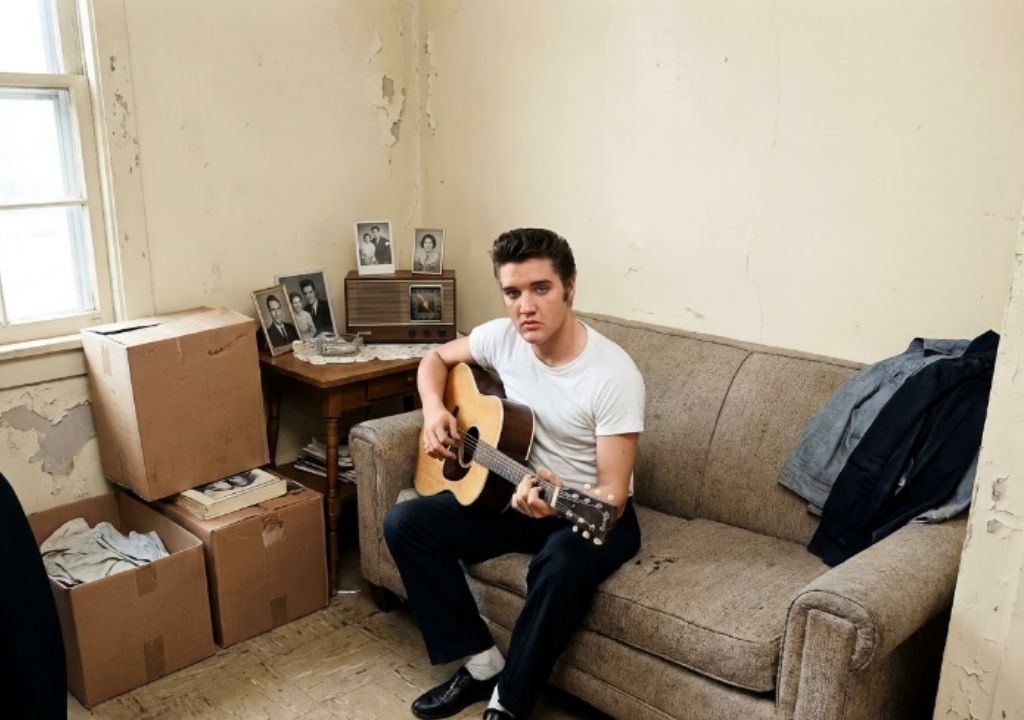
The structural safety and communal rhythm of Lauderdale Courts provided the young teenager with the precise emotional environment necessary to cultivate his blossoming musical instincts. Within the expansive brick quadrangle, Elvis fully immersed himself in a rich, vibrant tapestry of local sounds. He frequently retreated to the basement laundry room, where the natural, echoing reverberation amplified the warm tones of his acoustic guitar, allowing him to refine complex chord transitions late into the evening without disturbing neighboring residents. Furthermore, the strategic proximity of the housing project to Beale Street enabled Elvis to absorb a diverse variety of musical influences, seamlessly blending country rhythms, urban blues, and impassioned gospel harmonies into a singular personal style.
During these pivotal formative years from 1949 through 1952, Elvis balanced his high school education at L.C. Humes High School with endless hours of disciplined musical self-study. Fellow residents frequently recalled seeing the introspective youth resting on the concrete courtyard steps, practicing melodies with intense dedication. Rather than restricting his vision, the physical limitations of public housing cultivated profound empathy, grounded character, and fierce creative discipline. By the time the family relocated after exceeding income limits in November 1952, the essential foundation of a revolutionary cultural movement had been securely constructed within those humble brick walls.