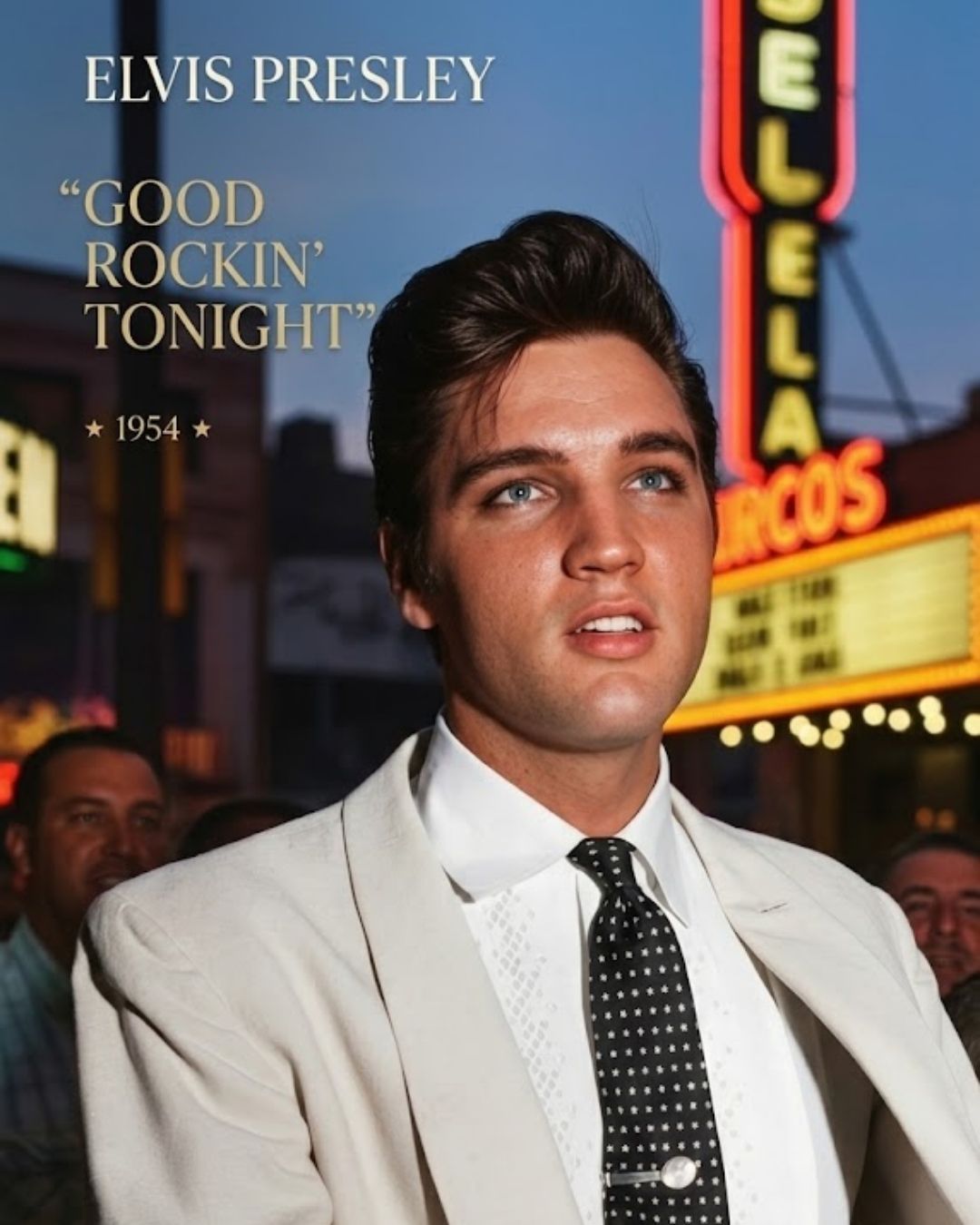
INTRODUCTION
On a warm September night in 1954, nineteen-year-old Elvis Presley stepped before the microphone at 706 Union Avenue in Memphis. Beside him, guitarist Scotty Moore tuned his Gibson while bassist Bill Black readied his upright instrument. Having already shaken local radio with his debut single, could this unproven truck driver prove that his explosive new sound was truly the future of music?
THE DETAILED STORY
When producer Sam Phillips gathered Elvis Presley, guitarist Scotty Moore, and bassist Bill Black at Sun Studio in September 1954, the stakes were incredibly high. Their July debut single featuring “That’s All Right” had generated excitement across Memphis, but critics questioned whether this new hybrid style was merely a passing novelty. Phillips urgently sought definitive proof that their sound represented a legitimate cultural movement. Seeking material with undeniable energy, Elvis turned to the rich catalog of rhythm and blues, selecting Roy Brown’s 1947 composition, which had been popularized in 1948 by Wynonie Harris.
In the hands of Harris, the original record had been a brass-heavy, rollicking jump blues anthem driven by honking saxophones and a roaring big-band groove. Elvis and his rhythm section boldly dismantled that arrangement. Stripping away the horns and piano, they rebuilt the song around a sparse, high-octane trio format. Bill Black provided the percussive engine, slapping the strings against the fretboard of his upright bass to create a sharp acoustic backbeat that compensated for the absence of drums.
Over this galloping rhythm, Scotty Moore delivered an extraordinary masterclass in electric guitar innovation. Blending country fingerpicking traditions with jazz chords and stinging blues bends, Moore’s solo on his Gibson became an enduring cornerstone of rockabilly technique. Anchoring the performance was Elvis’s voice—youthful, confident, and electrified with restless spirit. He altered the phrasing, introducing playful vocal hiccups, breathy pauses, and an ecstatic swagger that transformed a traditional blues tune into an urgent anthem of youthful rebellion.
Released on September 25, 1954, as Sun 210, the record cemented the trio’s reputation and expanded their regional touring power. It quickly became a centerpiece of their live appearances on the historic Louisiana Hayride radio show, where Presley’s kinetic stage movements triggered hysteria among young listeners. The track demonstrated that their blend of African American rhythm and blues with Southern hillbilly music was not an accidental studio experiment, but the foundation of an unstoppable musical revolution.
Decades later, musicologists celebrate the recording as a watershed moment where raw intuition replaced rigid studio formula. By stripping away convention and injecting unfiltered adrenaline, the session permanently codified the early rock and roll sound.