INTRODUCTION
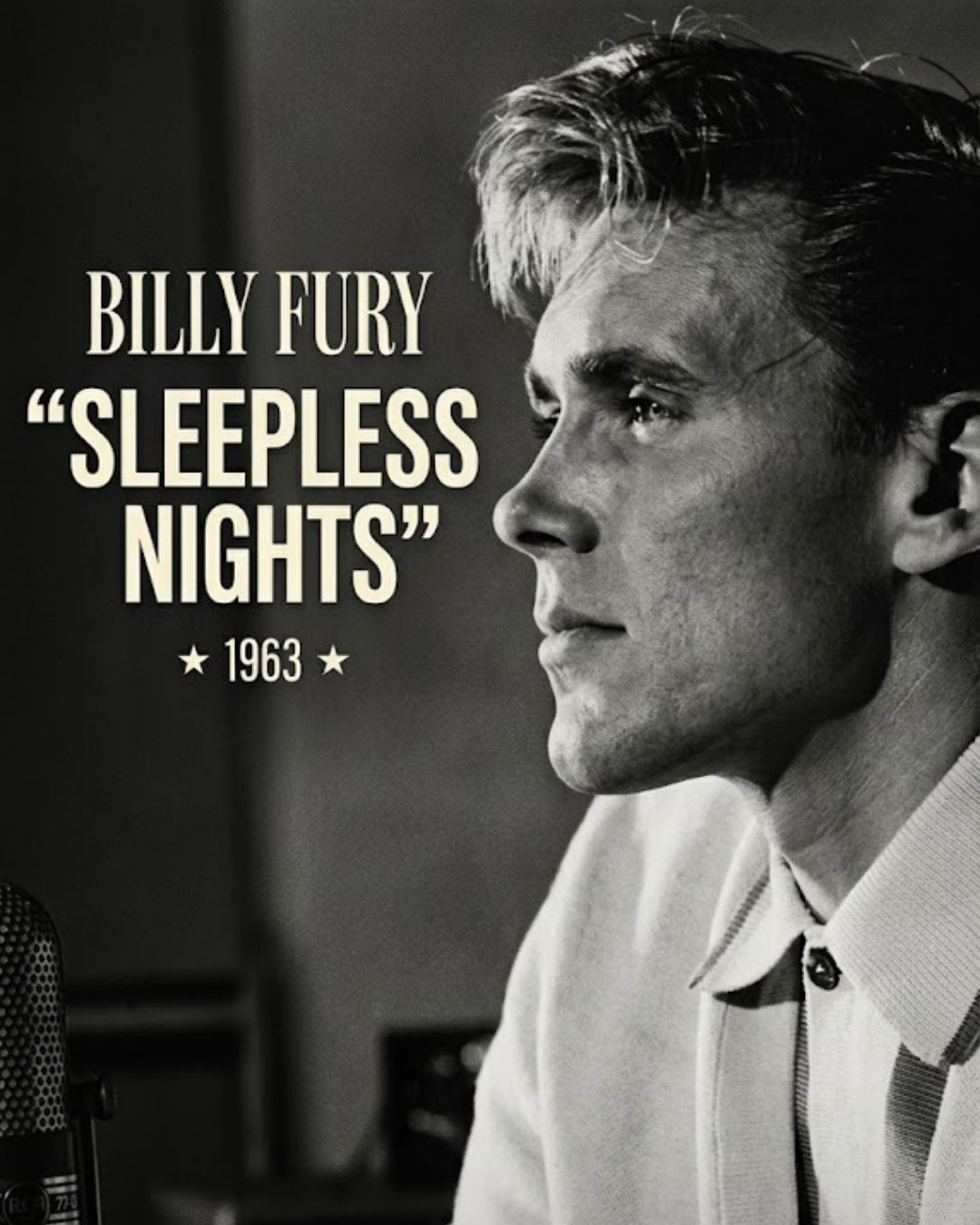
Inside London’s Decca Studios in late 1961, twenty-one-year-old Ronald Wycherley stood before the microphone under dim amber lights. While his contemporaries chased loud, swaggering rock and roll rhythms, the singer chose a path of stark, trembling quietude. He transformed an American standard into pure British heartbreak. But what made this overlooked recording one of his most deeply personal artistic statements?
THE DETAILED STORY
Written by the revered American songwriting duo Felice and Boudleaux Bryant, “Sleepless Nights” was originally popularized by the close-harmony perfection of The Everly Brothers in 1960. Yet, when Liverpool-born Billy Fury recorded his interpretation for Decca Records in 1961, he completely reimagined the song’s emotional architecture. Issued in December 1961 as the B-side to his smash single “I’d Never Find Another You”—which climbed to number three on the UK Singles Chart—Fury’s version stripped away the country-pop sheen to reveal something far more desolate, haunting, and intimate.
Where the Everlys found solace in shared fraternal harmony, Fury stood entirely alone in the darkness. His arrangement substituted tight vocal duet patterns with an understated, sweeping orchestration, punctuated by gentle acoustic guitar and poignant string swells. Fury’s phrasing was immaculate, balancing an innate rock and roll instinct with the refined sensitivity of a traditional crooner. He utilized delicate micro-pauses, gentle sighs, and an aching vibrato that mirrored the physical exhaustion of insomnia. Having suffered from severe rheumatic fever in his childhood—an illness that permanently damaged his heart and instilled a perpetual awareness of mortality—Fury possessed a natural melancholy that could not be manufactured. Every lyric about restless days and empty hours felt drawn directly from his own fragile reality.
During an era when British teen idols were routinely pushed toward theatrical exuberance, stage gimmicks, or formulaic uptempo numbers, Fury insisted on quiet authenticity. His vocal delivery on the track captures a rare nocturnal intimacy, turning what could have been a conventional commercial B-side into a masterclass in mood and restraint. The production deliberately gives his voice ample room to breathe, allowing the listener to hear every subtle vocal crack, sigh, and tremolo that established him as the most emotionally compelling British solo artist of his generation.
Decades later, “Sleepless Nights” stands as a vital touchstone in the evolution of early British pop. It bridged the gap between American rockabilly roots and the sophisticated orchestral balladry that would soon define the mid-1960s. Billy Fury did not merely cover a standard; he inhabited its sorrow, leaving behind a timeless testament to late-night solitude that continues to resonate with haunting power across generations of listeners.