INTRODUCTION
On a humid evening in late 1953, inside a cramped public housing apartment at Lauderdale Courts in Memphis, Tennessee, an intense argument erupted between Vernon and Gladys Presley. The disagreement centered on their eighteen-year-old son, who had recently graduated from Humes High School on 06/03/1953. Vernon, burdened by chronic poverty and eager for household stability, urged the youth to forego higher academic ambitions and accept immediate manual employment. Conversely, Gladys fiercely shielded her only child, terrified that long hours behind the wheel of a commercial vehicle would derail his fragile artistic inclinations and broader potential. Vernon insisted that practical labor was the family’s sole salvation, while Gladys viewed the decision as a compromise of his destiny. How did a fiery parental clash over a modest wage lay the groundwork for a revolution in popular culture?
THE DETAILED STORY
The emotional standoff between Vernon and Gladys Presley reflected the deep economic vulnerabilities of a working-class Southern family during the post-war era. Archival documentation preserved by historians at Billboard and Variety indicates that Vernon viewed steady employment as an urgent necessity. He envisioned his son training as a professional electrician, a respected trade that offered financial security far beyond the family’s historic struggles. However, Gladys harbored a protective intuition. She feared the physical hazards of commercial driving and worried that immediate immersion in grueling labor would extinguish her son’s creative spark.
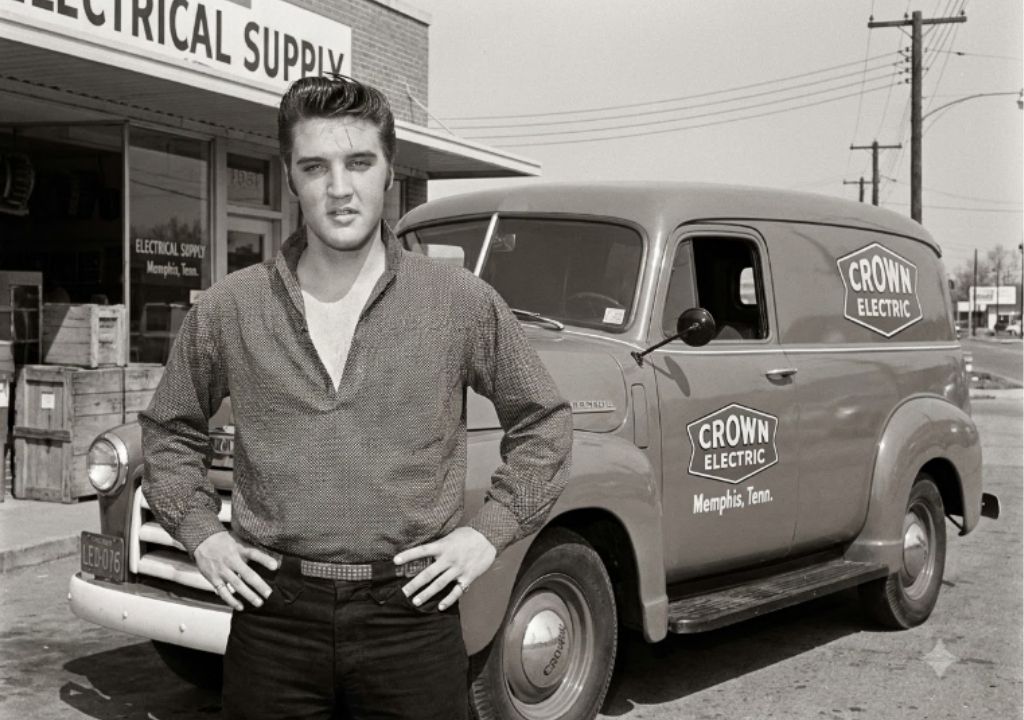
Despite her initial resistance, Gladys eventually relented after recognizing her son’s quiet determination to support the household while pursuing his musical aspirations. On 04/14/1954, Elvis Presley officially joined Crown Electric as a delivery truck driver, earning $1.00 per hour. The company owner, James Tipler, assigned the young man to haul electrical supplies across the bustling streets of Memphis. Far from stifling his creative spirit, the job provided an unexpected platform for personal and artistic development. Operating the delivery routes granted him unprecedented freedom to immerse himself in the vibrant urban soundscapes of Memphis, from gospel church services to the blues clubs along Beale Street.
Furthermore, the modest hourly wages allowed him to achieve financial independence while maintaining his signature pompadour hairstyle and distinctive clothing style from Lansky Brothers. Most importantly, the steady paycheck provided the exact funds required to fund his historic recording sessions at Sun Studio, where producer Sam Phillips was searching for an unprecedented sound. Driving the Crown Electric truck did not derail his journey; instead, it directly underwrote the birth of modern rock and roll. The heated debate that once threatened to divide the Presley household ultimately yielded the precise economic bridge needed to catapult an obscure truck driver into a global cultural phenomenon.