INTRODUCTION
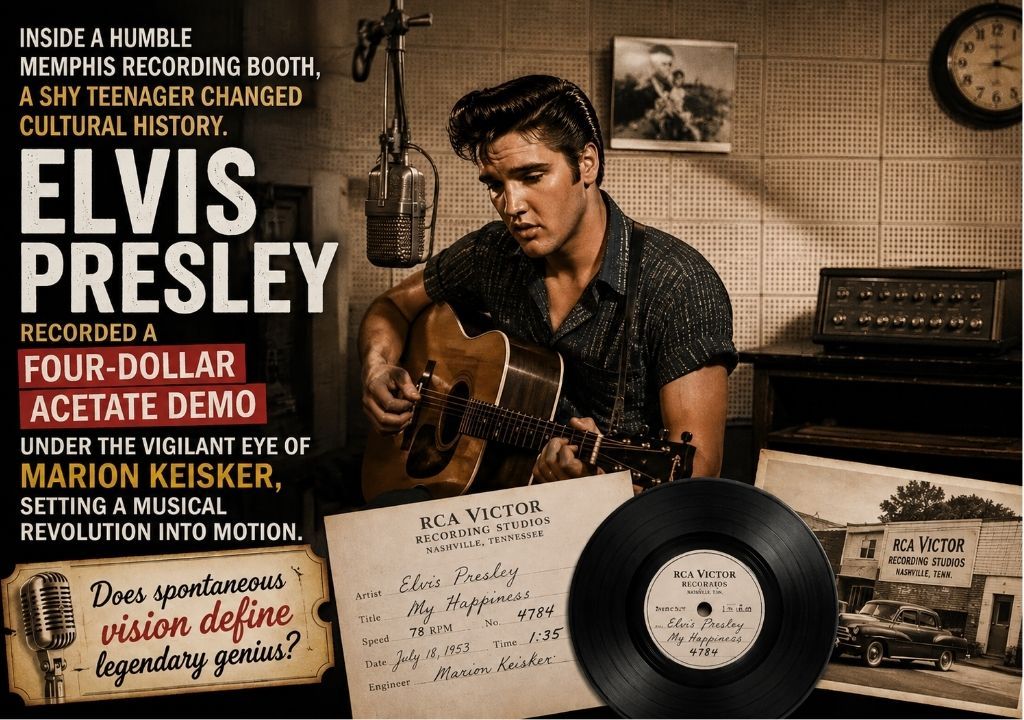
On a sweltering Saturday afternoon on 07/18/1953, an eighteen-year-old truck driver stepped out of the humid Memphis heat and into the modest office of the Memphis Recording Service at 706 Union Avenue. Clutching less than $4 USD earned from long shifts at the Crown Electric Company, the quiet youth sought to cut a personal two-sided acetate disc. To the casual observer, he was merely a polite teenager making a custom record as a heartfelt gift for his beloved mother. However, the air inside that unassuming storefront studio was already thick with latent ambition. Behind the front desk sat Marion Keisker, an astute broadcaster and studio manager whose sharp ear for authentic vocal timbre was about to alter the landscape of popular music forever. What transcendent quality did she recognize in a completely unknown amateur during those fateful four minutes?
THE DETAILED STORY
When Marion Keisker initiated the customary pre-recording interview at the reception desk, asking the young man what genre he specialized in, the eighteen-year-old delivered an iconic reply: “I sing all kinds.” Pressed further on which established musical artist he resonated with most, he offered a strikingly prophetic declaration: “I don’t sound like nobody.” Step-by-step, the quiet truck driver approached the studio microphone, delivering deeply earnest renditions of popular ballads “My Happiness” and “That’s When Your Heartaches Begin.”
Although studio founder Sam Phillips was absent from the building that warm afternoon, Keisker immediately discerned something extraordinary in the young singer’s phrasing—a rare, effortless synthesis of country sentimentality and soulful blues texture. Exercising rare professional foresight, she deliberately started an auxiliary reel-to-reel tape machine to preserve a duplicate demo recording while cutting the fragile acetate disc. On the studio log sheet, she precisely annotated a historic directive: “Elvis Presley. Good ballad singer. Hold.”
That solitary index card remained tucked away inside Sun Studio for nearly a year while the broader music industry continued its traditional routines. When Sam Phillips later voiced an urgent desire to discover a fresh performer capable of bridging distinct cultural genres with authentic emotional authority, Keisker promptly retrieved her preserved tape and championed the unknown truck driver’s undeniable potential. Her decisive advocacy directly sparked the historic 1954 recall that ultimately yielded “That’s All Right,” effectively launching a revolutionary cultural seismic shift.
This fateful 1953 session demonstrates that monumental artistic revolutions often hinge upon quiet moments of acute professional discernment. Elvis’s initial four-dollar investment was not merely a sentimental gesture for his mother, but an act of quiet artistic determination that met an extraordinarily perceptive talent scout. By capturing that unvarnished vocal demonstration, Keisker ensured that raw genius was carefully preserved rather than lost to history. Her sharp artistic vision catalyzed an epochal transformation in global entertainment, proving that an observant eye can forever redefine the trajectory of modern culture.