INTRODUCTION
The story did not begin in a grand concert hall or under the blinding lights of a Las Vegas residency. Instead, it started with a simple, unexpected inquiry from a friend seeking a used saxophone for his high school daughter. When Barry Manilow attempted to locate an instrument, he uncovered a troubling reality across the country: public school arts budgets were severely depleted, forcing music teachers to buy drumsticks and repair worn brass out of their own pockets. What began as a localized effort to acquire a single instrument rapidly evolved into a formidable philanthropic infrastructure. Driven by a conviction that creative expression is essential for adolescent development, the pop icon mobilized his fan base and professional network. But how did a modest impulse to help one student transform into a multimillion-dollar crusade that redefined music education nationwide?
THE DETAILED STORY
The institutional decline of music education in American public schools has long been treated as an inevitable consequence of municipal austerity. As district budgets contracted, arts programs were routinely the first line items eliminated, leaving classrooms with damaged instruments or empty storage closets. Recognizing that passive advocacy would not reverse this trend, The Manilow Music Project was established to intervene directly at the grassroots level. Operating with zero administrative overhead through a network of dedicated volunteers and management staff, the initiative focused on immediate, tangible solutions: placing playable instruments directly into the hands of students who otherwise could not afford them.
Over two decades of sustained effort, the foundation systematically expanded its footprint across North America. During national concert tours, venue partnerships identified severely underfunded local high schools in each host city. Through competitive voting programs, the organization introduced the Manilow Music Teacher Award, distributing $10,000 grants per city—splitting funds equally between direct classroom instrument donations and financial stipends for deserving educators. These targeted injections of capital revitalized struggling band programs, allowing directors to double ensemble sizes almost overnight.
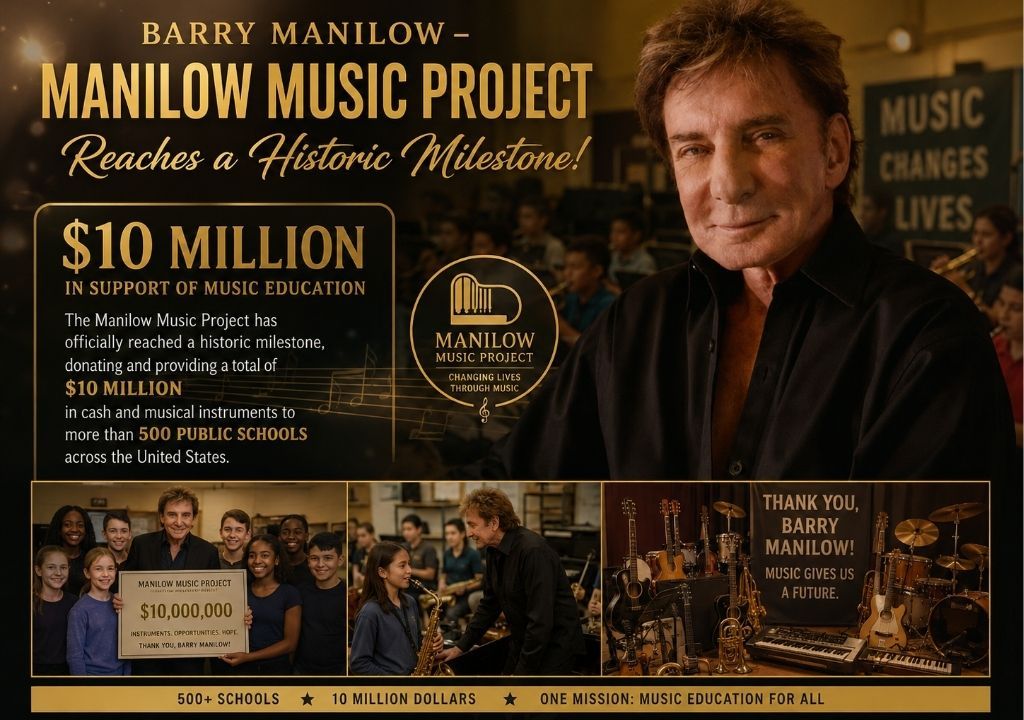
The impact of this model extends far beyond individual classrooms. To date, The Manilow Music Project has funded over $10 million in instruments and provided more than 300 performing arts scholarships to students nationwide. By donating instruments to 500 public schools, the project addresses a critical structural gap in secondary education. Educators report that access to quality instruments directly improves academic engagement, attendance rates, and community cohesion among participating youth.
In an era where corporate philanthropy often favors abstract initiatives, Barry Manilow has constructed a pragmatic framework centered on direct utility. The milestone of $10 USD million reflects not merely a financial figure, but thousands of young lives altered through artistic opportunity. As public funding for the arts remains fragile, this operational model demonstrates how sustained individual commitment can preserve essential cultural pathways for future generations.