INTRODUCTION
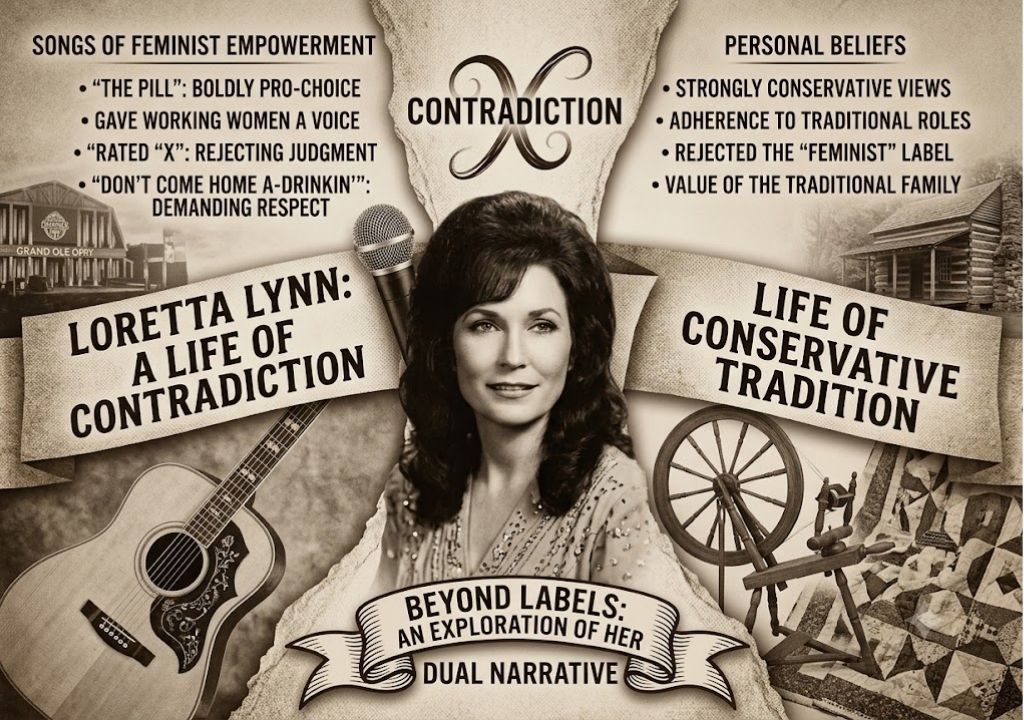
In 1975, the release of “The Pill” sent shockwaves through the conservative American heartland, challenging the taboos surrounding female autonomy and reproductive freedom. For a genre steeped in traditional narratives, Loretta Lynn became an unlikely herald of change, articulating the frustrations of housewives who felt trapped in domestic cycles. Yet, those who lauded her as a feminist icon often overlooked the woman behind the microphone, a devout daughter of the coal mines who clung to a traditional worldview that prioritized family hierarchy and rural modesty. This stark dichotomy created a fascinating tension in her public persona, leaving listeners to wonder: was she a radical revolutionary, or merely a storyteller giving voice to the unspoken truths of her own complicated life?
THE DETAILED STORY
The musical catalog of Loretta Lynn serves as a quintessential study in contradiction. While songs like “Don’t Come Home A-Drinkin’ (With Lovin’ on Your Mind)” empowered women to assert their boundaries against unfaithful or negligent husbands, the artist frequently distanced herself from the feminist movement of the 1970s. She often remarked that her songs were not political manifestos but simply reflections of the harsh realities she observed in her own kitchen and the lives of those around her.
Her disconnect from the broader political discourse of the era was not a matter of ignorance, but a firm adherence to the values of her upbringing in Butcher Hollow, Kentucky. She viewed her songs as conduits for survival rather than vehicles for social upheaval. When the National Organization for Women or other progressive groups claimed her as a champion of their cause, she often retreated into a narrative of domestic contentment and traditional womanhood. She maintained that a woman’s primary place was in the home, a stance that seemed at odds with the brazen independence showcased in her biggest hits.
This friction between her art and her identity defined her complexity. She was a woman who sang about the necessity of birth control while simultaneously upholding a worldview that was rooted in religious traditionalism. This duality did not diminish her influence; rather, it humanized her. By deciding she refused to conform to the narrow expectations of either liberals or conservatives, she became an authentic figure who was impossible to categorize. She sang about the raw, unfiltered experiences of her life, and because those experiences were messy and contradictory, her music resonated with millions. Ultimately, Loretta Lynn proved that one could challenge the status quo through song while still cherishing the traditions that shaped one’s character. Her legacy is not found in a rigid ideological box, but in the nuanced honesty of a woman who dared to sing about the truth, even when that truth was profoundly self-contradictory.