INTRODUCTION
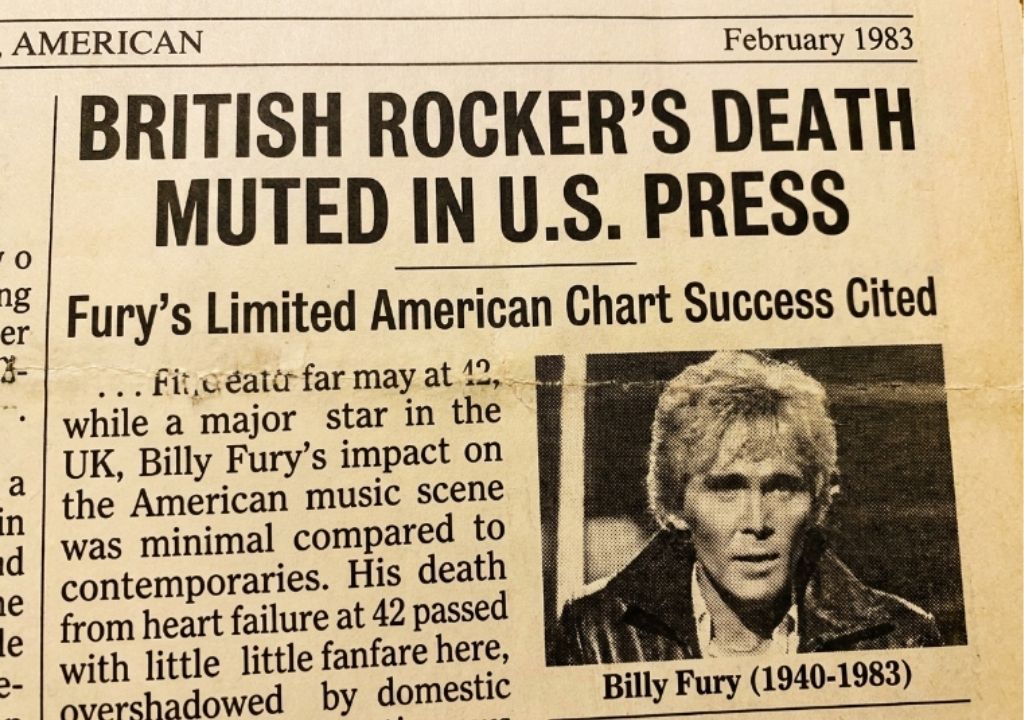
On the afternoon of 01/28/1983, the vibrant pulse of British rock and roll lost one of its foundational architects when Ronald Wycherley, known to millions as the magnetic superstar Billy Fury, succumbed to a fatal heart attack in London. While the United Kingdom plunged into national mourning for the pioneer who once rivaled Elvis Presley, a striking silence enveloped the major newsrooms across the Atlantic. Publications like Billboard and national television networks barely dedicated a column inch to the man who secured 29 charting singles in Great Britain. This stark contrast exposes a fascinating geopolitical disconnect in the entertainment industry, where massive domestic triumph does not always guarantee a global echo. Why did one of the most significant voices of the pre-Beatles era vanish so completely from the radar of the American media establishment at the exact moment of his final exit?
THE DETAILED STORY
To understand the media indifference surrounding the singer’s passing, one must examine the fierce structural mechanics of the mid-twentieth-century music trade. During his commercial zenith between 1959 and 1965, the Liverpool native possessed the smoldering charisma and vocal depth to challenge any contemporary. Yet, an insuperable barrier halted his global trajectory: a childhood battle with rheumatic fever left him with permanent heart valve damage. This critical health vulnerability prevented his management team, led by Larry Parnes, from orchestrating grueling promotional tours across the United States. Consequently, the artist never secured a US crossover hit, keeping his cultural footprint strictly confined to the European theater.
Furthermore, the timing of his passing at 06:30 AM ET in early 1983 coincided with a profound shift in American media priorities. By then, Variety and The Hollywood Reporter were laser-focused on the skyrocketing phenomenon of MTV and the Second British Invasion, which introduced synthesized pop icons to American audiences. The US news cycle had completely evolved, leaving little room for historical retrospectives on traditional European rockabilly figures who lacked a domestic catalog. Because the singer had spent the late 1970s in relative isolation on a Welsh farm dealing with tax issues, he lacked the corporate public relations machine necessary to penetrate American journalism.
Ultimately, American media ignores what it cannot directly commercialize for domestic consumers. Without a documented history of packed arenas in New York or high-grossing studio albums generating millions of dollars ($) in domestic revenue, his narrative lacked the industrial weight required to command front-page real estate across the United States. His quiet passing was not a structural failure of artistic talent, but rather a structural casualty of strict twentieth-century geographic market isolation. While Great Britain collectively remembered a legendary pioneer who shaped their musical identity, America simply moved forward with its modern broadcast schedule, proving that international cultural legacy is entirely bounded by the corporate borders of early distribution.