INTRODUCTION
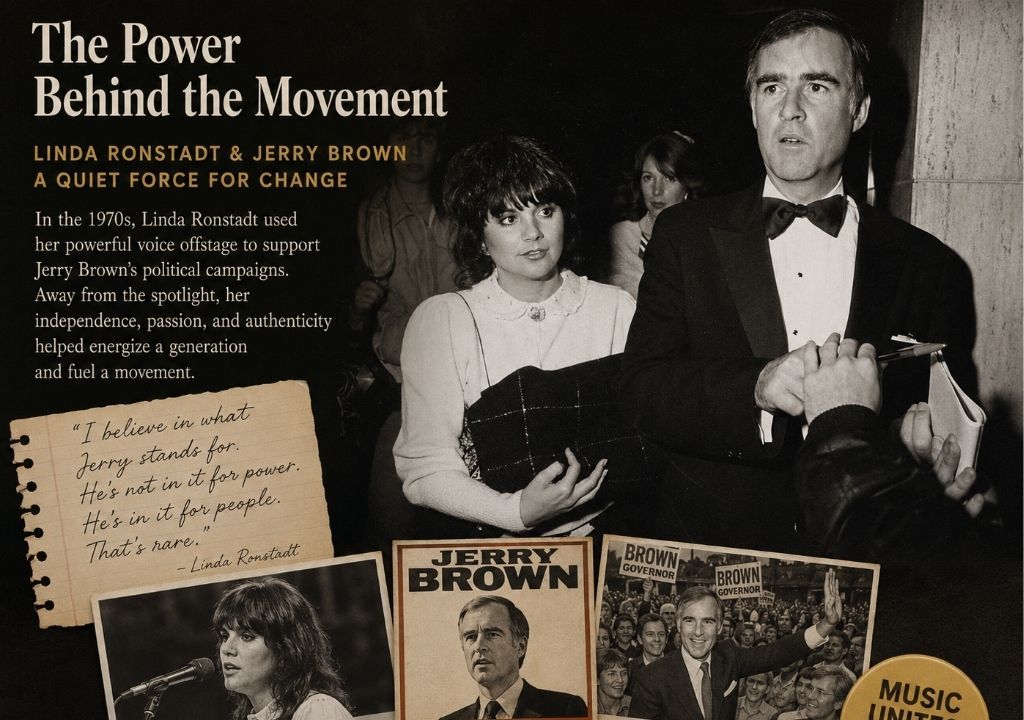
On the sweltering night of 05/16/1976, inside the packed Capital Centre in Largo, Maryland, the temperature rose to a humid 82 degrees Fahrenheit as 18,500 rock fans roared. Backstage, California Governor Jerry Brown stood quietly in a tailored pinstriped suit, sipping a beer. Out front, the undisputed Queen of Rock, Linda Ronstadt, commanded the microphone, delivering a blistering live set that raised $75,000 USD in a single evening for Brown’s outsider presidential primary bid. This was not a calculated corporate media event staged by urban publicists. Instead, it was an organic explosion of youth counter-culture, driven entirely by Ronstadt’s raw, uncompromised star power. By blending the worlds of West Coast rock and grassroots anti-establishment politics, Ronstadt injected an unprecedented natural energy into the American electoral system, demonstrating how private conviction could fundamentally reshape national history.
THE DETAILED STORY
The relationship between Linda Ronstadt and Governor Jerry Brown dismantled the rigid, transactional blueprint of traditional political alliances. Introduced in 1971 at Lucy’s El Adobe Cafe in Los Angeles, the pair shared a profound aversion to institutional opulence. While Brown rejected the grand California governor’s mansion to sleep on a mattress inside a modest rented apartment, Ronstadt maintained an unpolished, free-spirited lifestyle that actively defied the glossy expectations of the West Coast entertainment machine. When Brown launched his grassroots presidential primary campaign, Ronstadt became his ultimate strategic vanguards, leveraging her immense commercial appeal to circumvent federal campaign restrictions.
Under contemporary election laws, individual political contributions were capped at a strict $1,000 USD. However, a legislative loophole permitted entertainers to donate their live performance services without financial limits. Ronstadt masterfully capitalized on this mechanism. By organizing high-profile benefit concerts alongside icons like the Eagles and Jackson Browne, her musical infrastructure generated vast campaign assets. The legendary 1976 Maryland showcase alone translated into $225,000 USD after securing federal matching funds, single-handedly providing thirty-six percent of Brown’s entire campaign treasury at the time. Investigative tracking from Billboard and Variety documented this phenomenon as a radical paradigm shift, noting that rock musicians were effectively replacing traditional corporate fat cats as primary political kingmakers.
Despite the intense spotlight, Ronstadt fiercely protected her personal sovereignty. When national broadcast specials aired at 8:00 PM ET/PT analyzing their high-profile romance, or when the media swarmed their historic trip to Africa in April 1979, Ronstadt refused to be neatly packaged as a conventional political asset. She candidly informed reporters that rock ‘n’ roll and politics should remain separate, ensuring her artistic integrity was never compromised for electoral expediency. Her quiet power lay in this exact refusal to conform. By injecting an authentic, counter-cultural energy into Brown’s anti-materialist platform, Ronstadt proved that genuine artistic sovereignty could disrupt the most calculated political machinery in American history.