INTRODUCTION
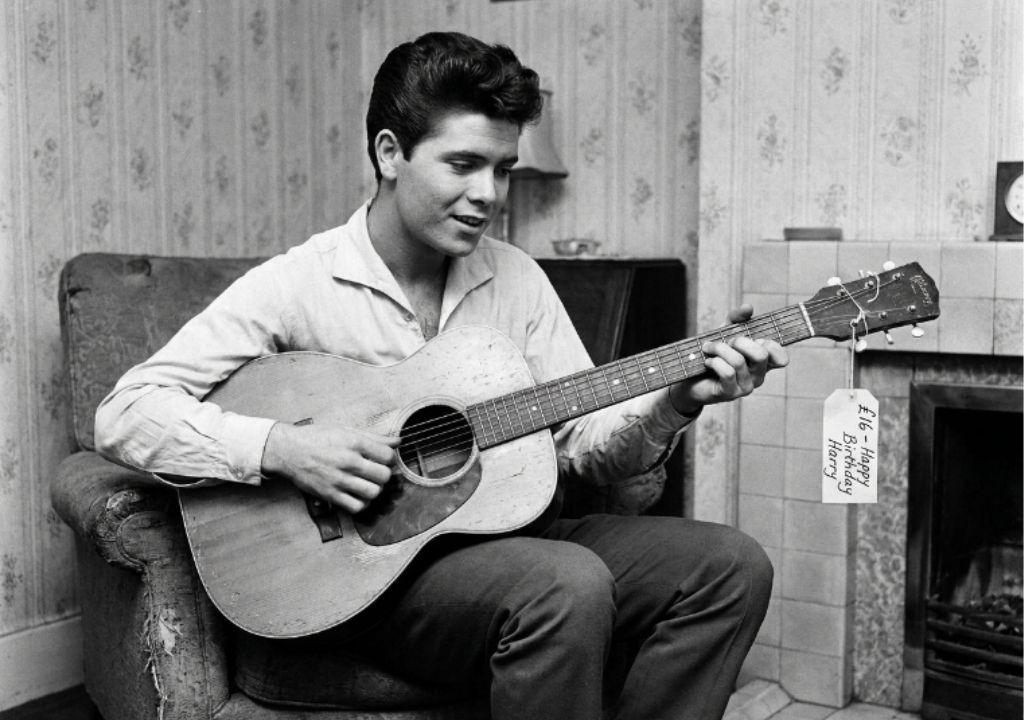
On the chilly autumn evening of 10/14/1956, a soft breeze swept across Hertfordshire, England, lowering the temperature to a crisp 50 degrees Fahrenheit. Inside a modest family home, a father named Rodger Webb handed his sixteen-year-old son, Harry Rodger Webb, a surprisingly light brown parcel. Inside lay an acoustic guitar that cost exactly sixteen pounds sterling—roughly equivalent to 45 USD ($45.00) at the time. To a cash-strapped family, this modest purchase represented a major financial sacrifice. Yet, this simple wood-and-string instrument would soon catalyze a cultural seismic shift across the United Kingdom. The young boy holding the guitar did not yet know he would soon discard his birth name to become Sir Cliff Richard. This humble birthday gift was destined to ignite the vibrant dawn of authentic British rock and roll, proving that legendary legacies often begin with the most unpretentious tools.
THE DETAILED STORY
The narrative of British pop stardom often centers on high-priced gear and polished London studios, but the reality of Cliff Richard’s genesis is far more grounded. In the vibrant mid-1950s, the United Kingdom was gripped by the skiffle craze, a DIY musical movement that compelled teenagers to build makeshift instruments out of washboards and tea chests across working-class neighborhoods. For young Harry Webb, who had moved from British India to a small council house in Cheshunt, music was an escape. Recognizing his son’s passionate obsession with the driving rhythms of Bill Haley and Elvis Presley, Rodger Webb saved scraps of wages to buy the infamous sixteen-pound acoustic guitar. It was a basic, generic model with high action that made fingers bleed, yet it altered everything.
Armed with this cheap instrument, the teenager formed a school vocal harmony group called The Quintones in 1957, eventually migrating to the Dick Teague Skiffle Group. The primitive acoustic guitar served as his training ground, allowing him to master the essential chord progressions that defined early rock and roll. By early 1958, he fronted a raw rock group called the Drifters. It was during this intense rehearsal period that entrepreneur Harry Greatorex and guitarist Ian Samwell realized the charismatic singer needed a tougher persona. They christened him Cliff Richard—a name evoking a rugged cliff face and honoring his musical idol, Little Richard.
When the band entered the studio to record “Move It” in the summer of 1958, that same sixteen-pound acoustic guitar provided the rhythm backbone under Ernie Shears’ blistering electric lead. Released as a B-side, “Move It” shocked radio programmers when it hit the airwaves at 07:00 PM ET/PT, exploding into a historic phenomenon and peaking at number two on the UK Singles Chart. John Lennon famously credited the track as Britain’s first authentic rock record. Though Richard later transitioned to high-end instruments, including a famous imported red Fender Stratocaster, the foundation of his enduring multi-million USD ($) career rests entirely on his father’s humble sixteen-pound investment. It proved that rock stardom is born of passion, not exorbitant price tags.