INTRODUCTION
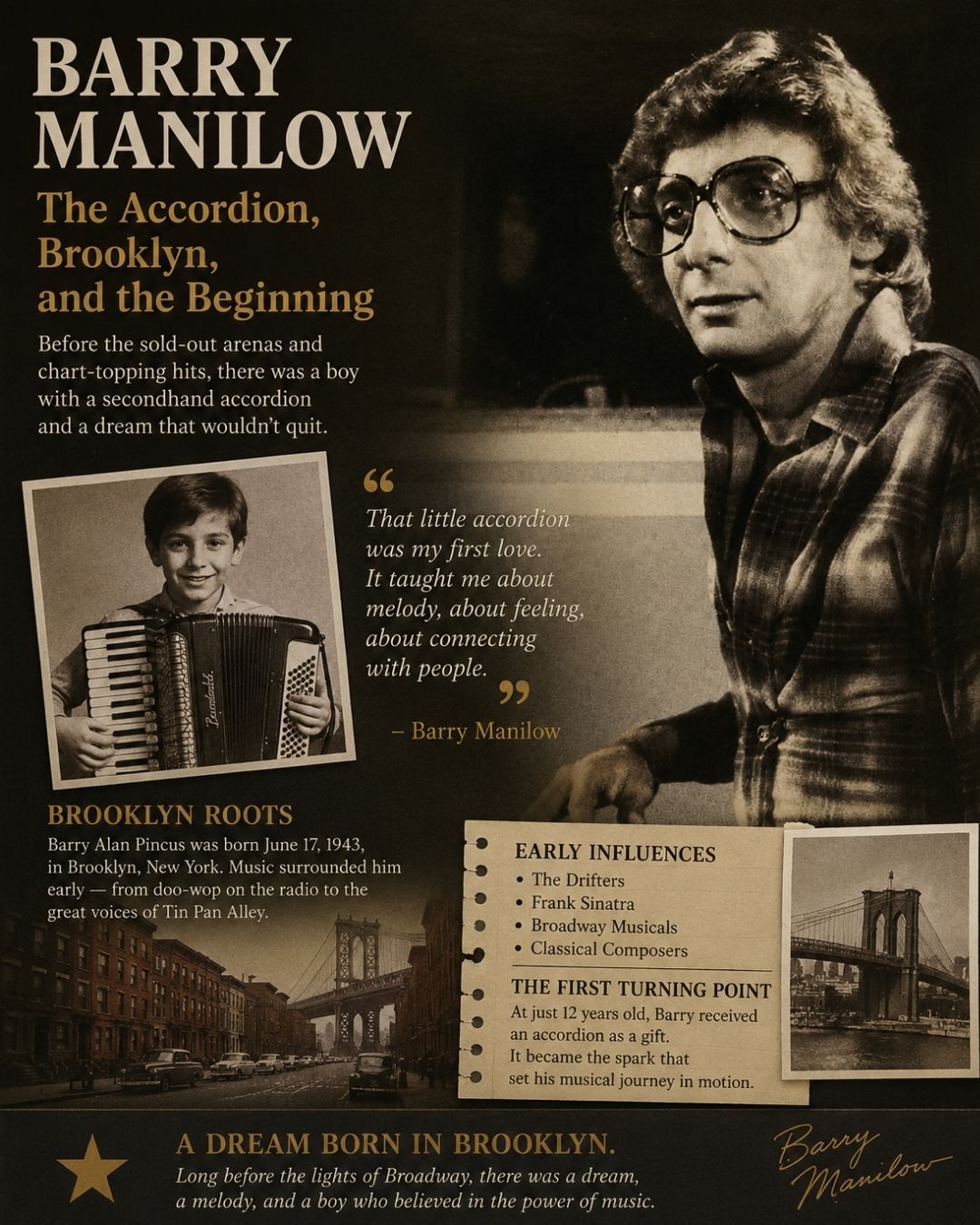
On a sweltering summer day in Williamsburg, Brooklyn, a seven-year-old boy unwrapped a modest birthday gift that would fundamentally alter the trajectory of American popular music. The year was 1950, and the neighborhood was a dense, blue-collar enclave far removed from the glamorous neon lights of Broadway. The boy was Barry Manilow, then known as Barry Alan Pincus, and the gift was not a grand piano, but a basic mechanical accordion. Purchased through the quiet, grueling sacrifices of his single mother, Jean Pincus, this heavy, bellows-driven instrument became the future icon’s gateway into the world of sound. Long before he ever touched the ivory keys of a concert grand, the physical mechanics of the accordion forced a raw, intuitive understanding of harmony and rhythm, laying the vital structural groundwork for a legendary career that would eventually define the twentieth-century adult contemporary landscape.
THE DETAILED STORY
To truly comprehend the sweeping orchestral grandeur of iconic hits like “Mandy” or “Copacabana,” one must first dissect the raw acoustic environment of a cramped apartment on the skipped-beat streets of mid-century Brooklyn. The Williamsburg of Manilow’s youth was a vibrant yet challenging melting pot of immigrant ambitions and severe economic hardship. Raising a child entirely alone, his mother Jean Pincus recognized an irrepressible, innate artistic spark within her young son. Quietly saving dollar by dollar in an era where basic domestic utilities were considered a luxury, she managed to secure a standard mechanical accordion for his seventh birthday on June 17, 1950. While neighborhood peers played in the industrial shadows of the local waterfront, Manilow completely immersed himself in the bellows, keys, and buttons of an instrument often unfairly dismissed by classical purists.
Yet, this rustic device served as his definitive masterclass in independent hand coordination and complex harmonic layering. The structural mechanics of the accordion require a musician to simultaneously execute intricate bass rhythms with the left hand while articulating fluid melodic lines with the right, all while physically pumping the central bellows to sustain the notes. This intense, tactile engagement with physical sound cultivated a highly sophisticated sonic spatial awareness early on. When his stepfather, Willie Murphy, later introduced a spinet piano and a vast, transformative collection of jazz and classical records into the household, Manilow did not simply abandon his rustic roots; he masterfully translated them. The massive, swelling choruses and dramatic, operatic key changes that eventually became his signature trademark on the global Billboard charts were directly informed by the compressed rhythmic power of that first childhood instrument. This investigative look back at his formative years proves that his monumental multi-platinum legacy was never an overnight fluke of corporate marketing, but a brilliant destiny forged through authentic working-class grit and an unyielding, lifelong devotion to musical architecture.