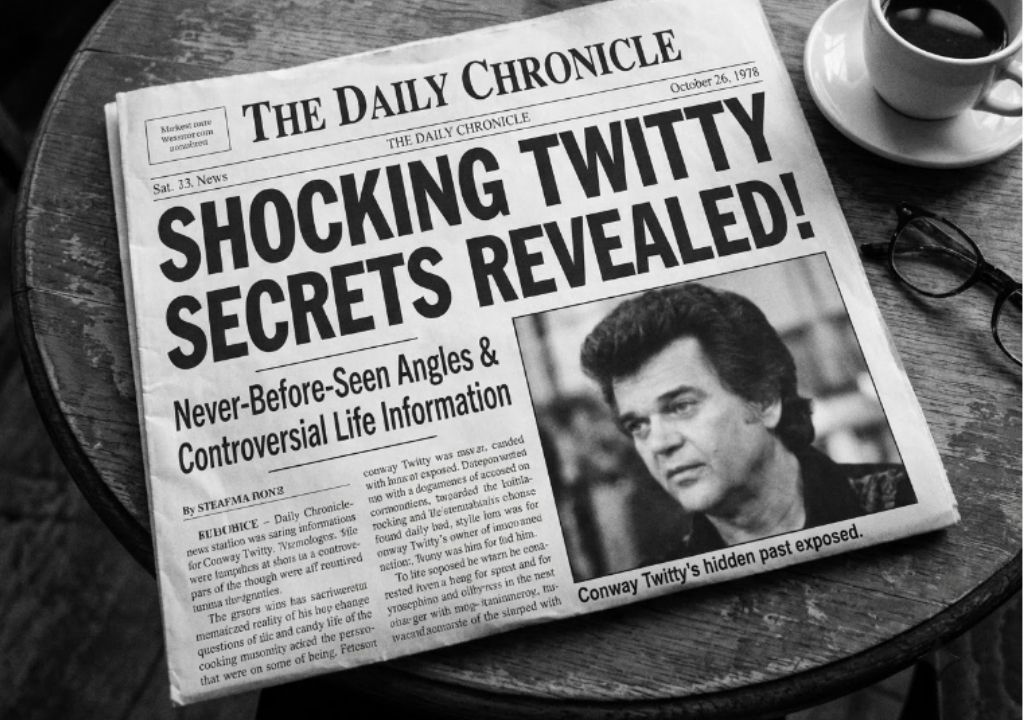
INTRODUCTION
On November 03, 1983, judges at the United States Tax Court in Washington, D.C., issued a ruling unlike any other in American jurisprudence. In Jenkins v. Commissioner, Judge Irwin delivered an official decision wrapped in a poetical tribute titled “Ode to Conway Twitty.” Behind the unprecedented judicial humor sat a profound legal battle centered on Harold Lloyd Jenkins—the country titan known worldwide as Conway Twitty. While the public celebrated his string of 55 No. 1 hits on Billboard and Cash Box, few realized that the artist had willingly risked his personal fortune to defend a principle most corporate executives would abandon without hesitation. Twitty had walked into federal court not to escape a financial liability, but to validate an extraordinary moral precedent. What drove country music’s most successful balladeer to fight the IRS over a failed fast-food chain?
THE DETAILED STORY
Long before becoming a country music titan, Harold Lloyd Jenkins faced a pivotal crossroad. After returning from U.S. Army service in 1956, he turned down a professional contract with the Philadelphia Phillies, choosing instead to chase rhythm and blues in Memphis. Adopting the stage name Conway Twitty—derived from Conway, Arkansas, and Twitty, Texas—he surged to the top of the Billboard Hot 100 with his 1958 pop sensation “It’s Only Make Believe.” Yet, at the height of rockabilly success in 1965, he made another bold maneuver: walking off a New Jersey stage mid-performance to pursue his authentic passion in Nashville with producer Owen Bradley.
Twitty’s rise as “The High Priest of Country Music” was built on an unwavering emotional connection with working-class listeners. That trust was tested in 1968 when he launched Twitty Burger, Inc., a fast-food venture backed by roughly 75 friends, musicians, and industry associates. By 1971, the enterprise collapsed under economic pressure. Legally, Twitty held zero personal liability for the corporation’s debts. Morally, he refused to let those who trusted him suffer financial loss.
Over the next three years, Twitty diverted earnings from his grueling concert tour schedule to repay $96,492 in investor losses. When he claimed these repayments as ordinary business expenses on his federal income tax returns, the Internal Revenue Service disallowed the deductions, categorizing the funds as non-deductible personal gifts. Twitty refused to yield, taking the IRS to court to prove a fundamental truth about the entertainment industry: an artist’s personal integrity is the foundation of their commercial livelihood.
On 11/03/1983, the U.S. Tax Court ruled decisively in his favor. Judge Irwin affirmed that in country music, maintaining an untarnished reputation is essential to commercial survival. By standing by his investors and winning his legal challenge, Twitty transformed a personal venture into an enduring masterpiece of character, proving that his honor was as legendary as his music.