INTRODUCTION
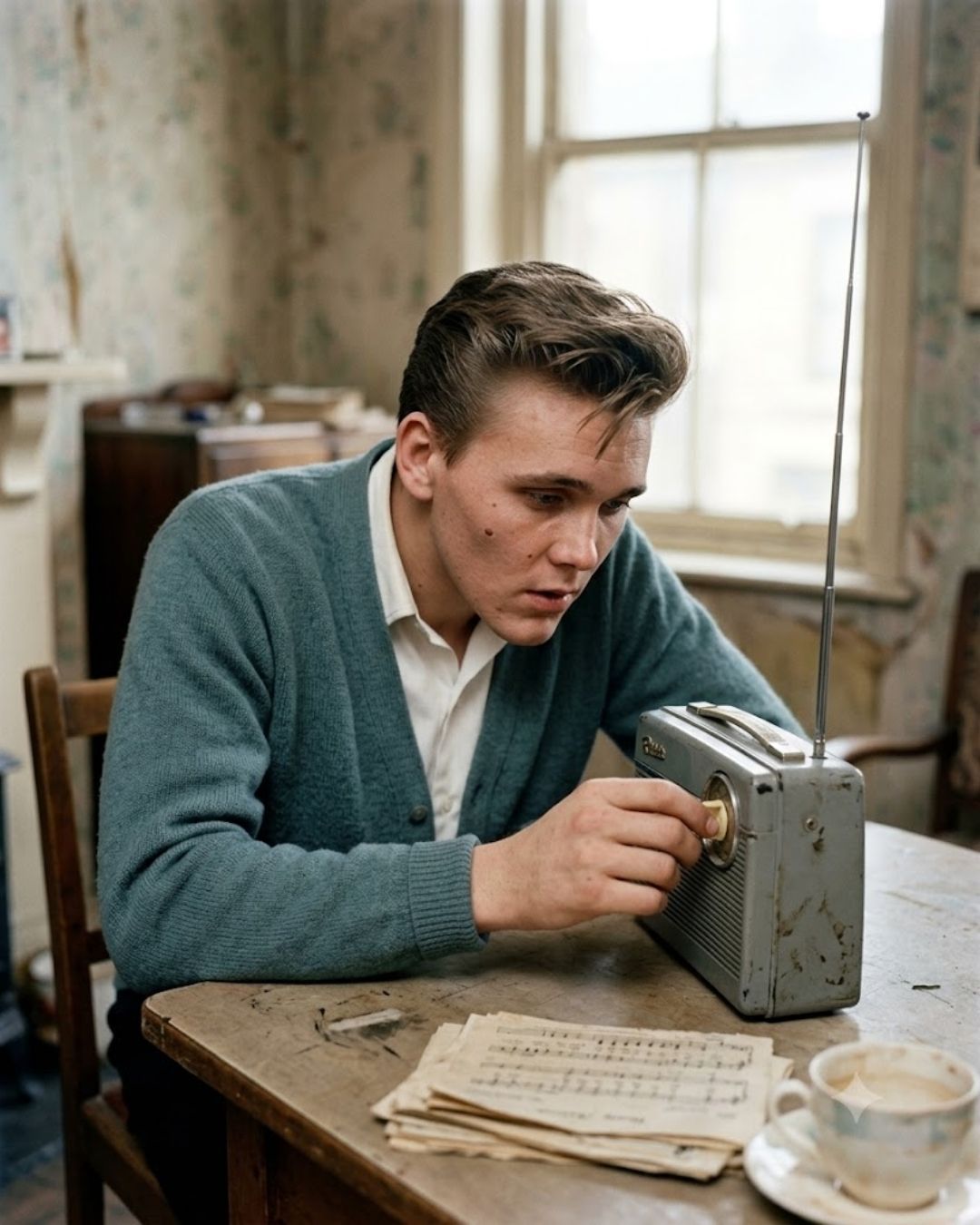
Tucked deep within the working-class grid of The Dingle in Liverpool, the two-up, two-down terrace at 35 Haliburton Street offered little shelter from the damp Mersey winds. Here, long before the marquee lights of London beckoned, lived Ronald Wycherley—a fragile boy confined to bed by recurring bouts of rheumatic fever. With no indoor plumbing and money perpetually scarce, survival was measured in small mercies and relentless grit. Yet inside those cold brick walls, an extraordinary lifeline materialized when an old battery-operated accumulator radio began filling the bedroom with mysterious sounds from across the Atlantic. For a sick child navigating isolation, those crackling frequencies became far more than simple domestic entertainment. How did a modest box powered by acid cells silently transform an ailing dockland youth into Britain’s most sensitive rock and roll pioneer?
THE DETAILED STORY
Born on 04/17/1940, Ronald Wycherley grew up in the shadow of Liverpool’s southern docks, where poverty was an ambient condition rather than a temporary hardship. The brick terrace at 35 Haliburton Street possessed neither luxury nor warmth, heated only by a modest coal grate. When rheumatic fever struck him at age six, it permanently damaged his heart valves, sentencing the young boy to extended hospital stays and prolonged home convalescence. While other neighborhood boys played along the Mersey wharves, Ronnie was immobilized within the quiet confines of his bedroom.
To ease his solitude, his parents secured a bulky radio powered by a heavy wet-cell accumulator battery. Recharging that battery required lugging the glass cell to the local corner shop every week, an expense the working-class household prioritized solely to comfort their ailing son. Through the speaker’s static drifted nocturnal transmissions from Radio Luxembourg and the American Forces Network. Ronnie absorbed the raw emotional phrasing of American country blues, gospel harmonies, and Western swing, internalizing a sonic language completely distinct from standard British music hall fare.
That battery radio did not merely pass the hours; it cultivated an innate musical architecture. Unable to participate in strenuous physical activity, Ronnie channeled his longing into verse, teaching himself guitar chords to accompany the melodies echoing from the small receiver. Unlike his contemporaries who later imitated American rock and roll through theatrical bravado, Wycherley’s delivery developed as an intimate, bruised confession born of physical vulnerability.
When impresario Larry Parnes discovered him backstage in late 1958 and rechristened him Billy Fury, London’s commercial machinery encountered a singular anomaly: a working-class northern youth performing his own hauntingly delicate compositions rather than formulaic pop covers. The remarkable authenticity that subsequently yielded 24 UK chart hits traced directly to the hours spent beside that crackling loudspeaker on Haliburton Street. In transforming domestic hardship into enduring melody, that humble brick terrace gifted British music one of its most profound and lasting voices.
Video: Billy Fury – Halfway to Paradise