INTRODUCTION
When a high school band director in St. Louis walked onstage during a major concert tour, she did not step up to conduct, but to accept a vital grant for her students. Across North America, music programs are silently folding under brutal municipal budget cuts. Why did one of pop music’s greatest showmen decide to personally intervene and rebuild these fading music rooms from the ground up?
THE DETAILED STORY
The crisis of American public arts education rarely captures national headlines, yet its consequences ripple across generations. For decades, municipal budget reductions have quietly targeted music programs, leaving classrooms with cracked violins, broken brass, and devoted educators purchasing basic supplies out of their own pockets. The genesis of this philanthropic intervention began with a deceptively simple request when a close friend asked Barry Manilow for help locating a saxophone for his high school daughter. Discovering that even reputedly solid school districts lacked functional instruments, the Grammy-winning artist uncovered a systemic failure that threatened to silence young talent across the nation.
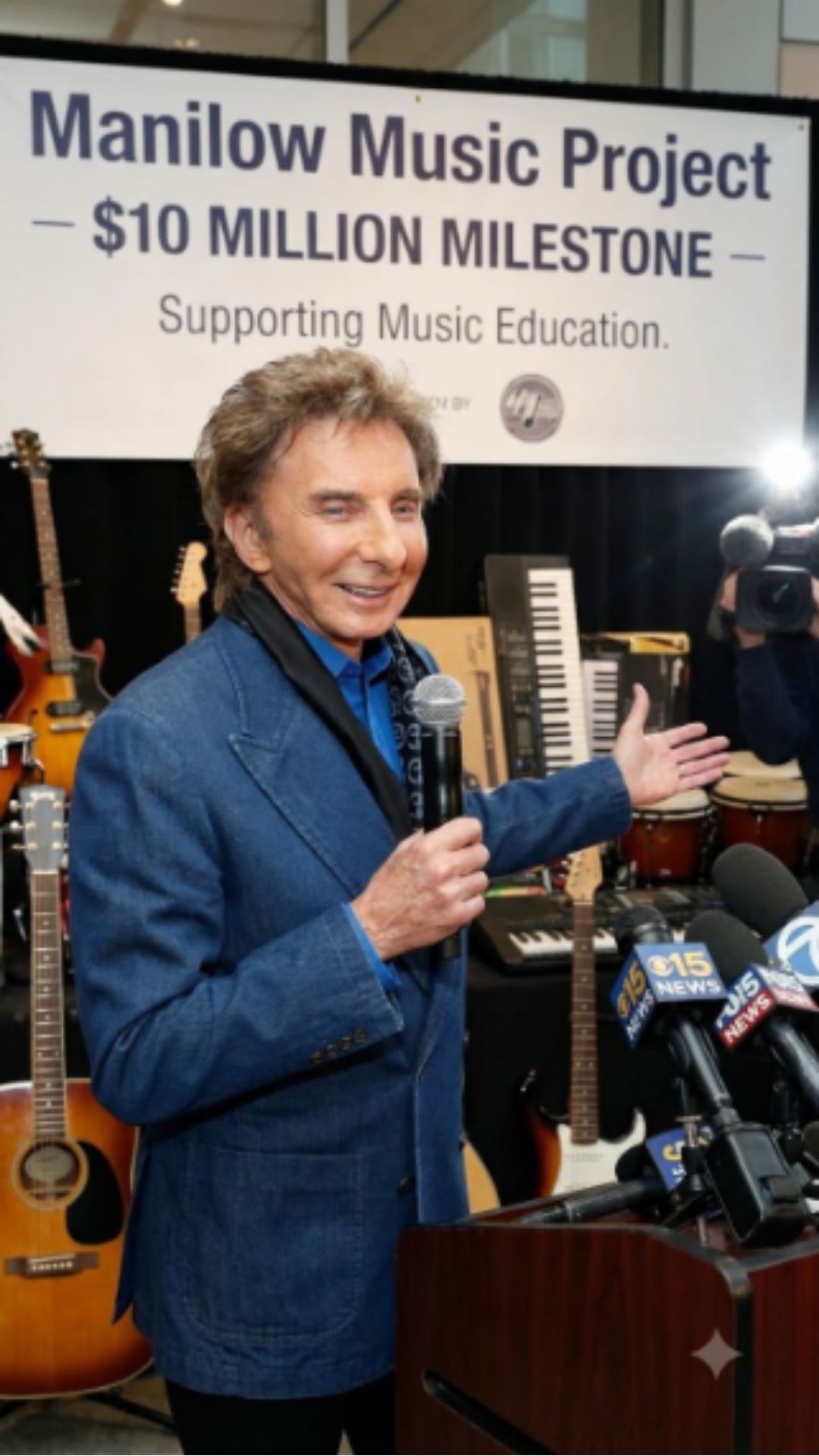
Refusing to remain a passive bystander, the legendary composer launched the Manilow Music Project to directly counter these institutional deficits. Operating with a remarkably streamlined structure of community volunteers and management staff, the initiative bypasses administrative inertia to deliver tangible resources directly into student hands. Alongside its celebrated annual teacher recognition program—which awards $10,000 grants to outstanding band directors in concert cities throughout North America—the foundation has officially donated over $10 million in instruments and academic scholarships to underfunded middle schools, high schools, and colleges. From replacing entire instrument inventories destroyed by natural disasters to gifting brand-new grand pianos to underprivileged prodigies, the program provides top-grade equipment that allows students to participate without financial barriers.
This monumental financial milestone represents far more than traditional charity; it stands as a strategic investment in human potential, cognitive development, and community cohesion. Academic research consistently demonstrates that structured musical education sharpens spatial-temporal reasoning, improves classroom retention, and fosters critical emotional resilience among adolescents. By ensuring that personal economic hardship never prevents a child from joining the school band, the project preserves an essential pipeline for creative expression and personal growth.
In an entertainment industry where celebrity philanthropy often begins and ends with short-lived social media campaigns or temporary press releases, Barry Manilow has established a gold standard for sustainable civic engagement. By systematically transforming commercial success into foundational educational support, he demonstrates that a performer’s ultimate cultural legacy is measured not merely by chart-topping records or arena attendance, but by the vibrant sound of young musicians discovering their artistic voice for the very first time.