INTRODUCTION
In the mid-1960s, British cinema frequently sought to capitalize on the explosive global reach of rock-and-roll culture by engineering highly formulaic, heavily commercialized musical films. Yet, when Liverpool pop sensation Billy Fury stepped onto the set of his 1965 production, I’ve Gotta Horse, he broke the standard corporate playbook entirely. Captured in vibrant Techniscope, this unique semi-autobiographical musical comedy was not merely a superficial vehicle designed to showcase radio hits; it served as a vivid, transparent mirror of Fury’s profound, lifelong love for animals. By constructing a narrative around the real-world chaos of introducing a live thoroughbred into a pristine theatrical environment, Fury introduced a raw, unpolished authenticity to British screens. This artistic decision bypassed rigid corporate paradigms and bridged the gap between a sheltered teen idol and an adoring mass audience that deeply resonated with his genuine, unscripted character.
THE DETAILED STORY
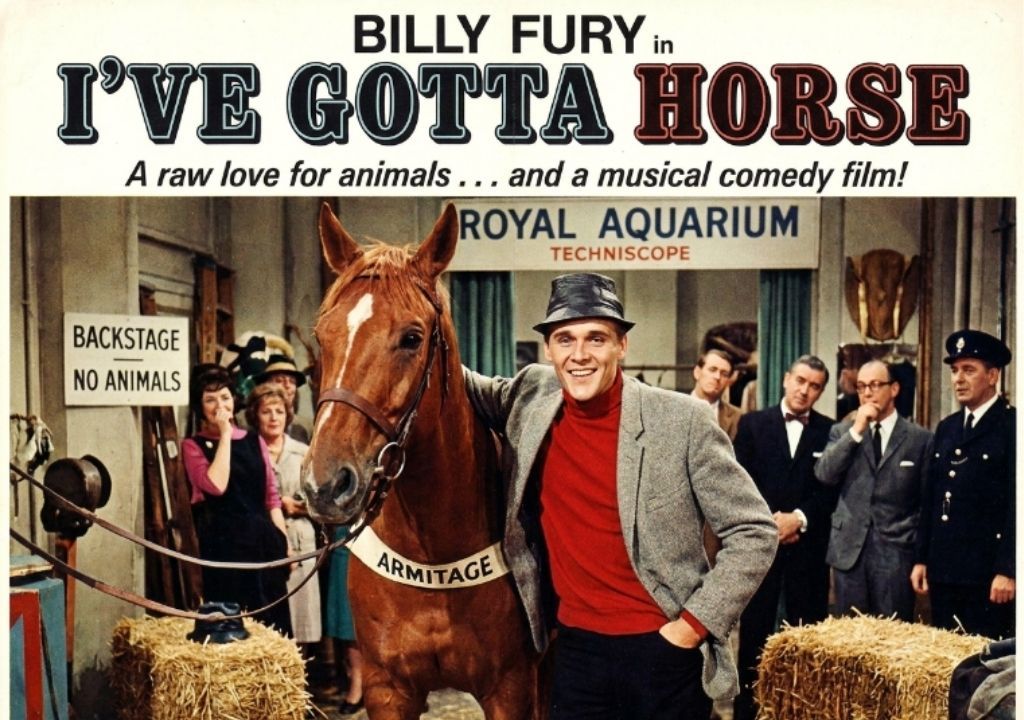
The structural brilliance of I’ve Gotta Horse lies in its unapologetic reliance on Billy Fury’s actual eccentricities and real-life personal passions. The film’s narrative arc directly mirrored a series of actual, tumultuous events centered around Fury’s summer performance season at the historic Royal Aquarium Theatre in Great Yarmouth. In the film, Fury’s character attempts to acquire a simple sheepdog to add to his growing personal menagerie, only to mistakenly purchase an irresistible, thoroughbred racehorse named Armitage instead. Confronted with the immediate administrative fury of his traditional show manager, Fury surreptitiously smuggles the massive animal into the cramped backstage dressing rooms and rehearsal spaces of the theater. The resulting narrative havoc shattered the highly structured, predictable boundaries dictated by the venue’s conservative management, turning the prestigious theatrical space into an anarchic comedy of errors.
This on-screen rebellion was anchored by an absolute adherence to reality. Rather than relying entirely on trained Hollywood animals, Fury insisted on utilizing his own personal dogs and his actual prized racehorse, Anselmo, for the production. This convergence of autobiography and cinematic fiction generated a profound underground current of empathy among contemporary audiences. The British working class, accustomed to seeing their pop heroes in highly sanitized, strictly controlled media packages, witnessed an artist who actively preferred the unconditional companionship of animals to the exhausting superficiality of showbiz elitism.
Filmed partly at the Royal Aquarium Theatre and Shepperton Studios on a budget of approximately $560,000, I’ve Gotta Horse bypassed established industry expectations. While contemporary film critics occasionally dismissed the plot as lightweight, the film achieved massive commercial resonance because it allowed Fury to project his true, gentle self. By staging musical numbers alongside his beloved pets, he effectively democratized the pop star aesthetic. Ultimately, the 1965 film stands as a monumental cultural artifact, documenting the precise moment an enigmatic rock star weaponized his personal passions to conquer the silver screen.