INTRODUCTION
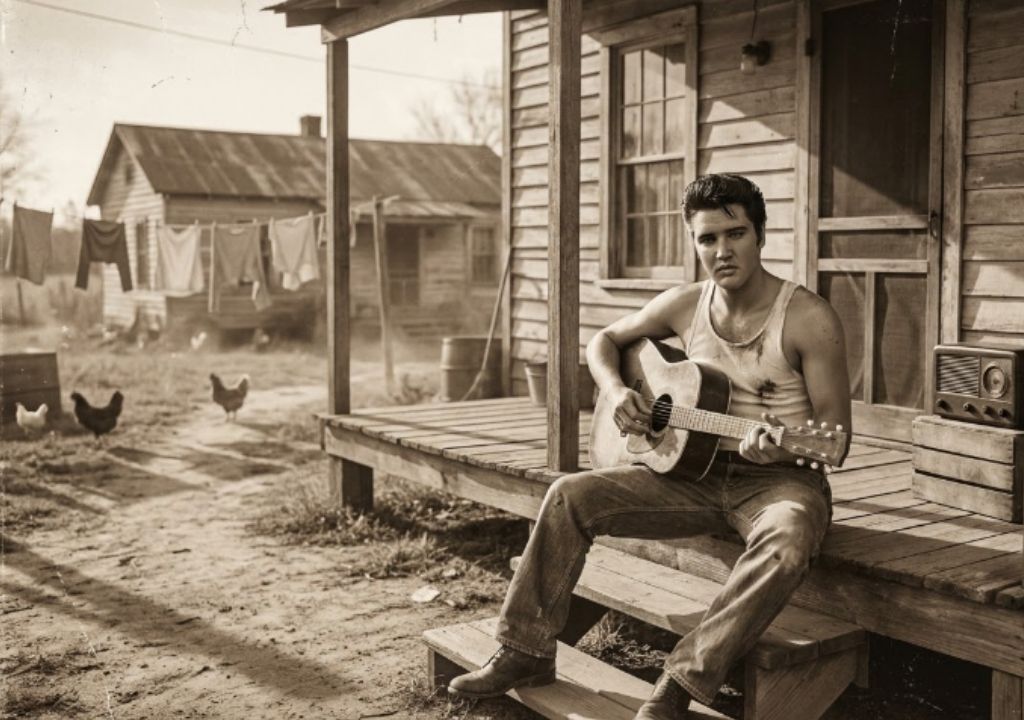
In a stark two-room shotgun house in Tupelo, Mississippi, constructed by his father for less than $180 USD, a young boy spent his formative years facing severe economic deprivation. Following his father’s imprisonment in 1938 for altering a check, the household collapsed into absolute poverty, forcing the family to relinquish their home and depend on local church charity and government relief programs. Amidst raw hardship, the child found solace in church assemblies and rural gospel choruses that echoed across Lee County. The stark contrast between material scarcity and emotional expression shaped his world. Yet, how did this period of profound vulnerability lay the foundation for an unprecedented cultural revolution?
THE DETAILED STORY
Historical records archived by Southern heritage studies detail how the family navigated the late 1930s relying on government welfare relief for basic groceries. When Vernon Presley began serving his three-year sentence at the Mississippi State Penitentiary on 05/25/1938, his wife Gladys Presley worked sporadic domestic and sewing jobs to secure essential food items. Community members and local welfare agencies frequently delivered flour, cornmeal, and canned goods to sustain the young mother and her son during their most desperate months in East Tupelo.
Rather than defeating his spirit, this extreme austerity cultivated an extraordinary empathy and musical receptivity in Elvis Presley. Surrounded by the soulful acoustic traditions of working-class Mississippi, he absorbed blues, gospel, and country rhythms that flourished outside mainstream commercial channels. Historians writing for Billboard and The Hollywood Reporter have long noted that his early exposure to communal resilience deeply informed his artistic authenticity. The hunger he experienced was not merely physical; it translated into a fierce, expressive drive that infused his vocal delivery with unmatched emotional urgency.
When the family eventually relocated to Memphis in November 1948, the indelible lessons of Tupelo remained fully intact. His humble origins instilled a lifelong humility and a profound respect for grassroots American musical roots. Later in life, after becoming a cultural titan whose global record sales surpassed hundreds of millions of dollars, he quietly funneled substantial wealth into charitable causes across Tennessee and Mississippi, never forgetting the painful reality of childhood poverty.
The narrative of Tupelo is not merely a tale of economic struggle, but a testament to how adversity can refine artistic genius. By converting early deprivation into emotional resonance, he created a sound that erased cultural barriers across the globe. Ultimately, the boy who once depended on charitable food baskets grew to become the definitive architect of rock and roll, proving that transcendent talent can emerge from the humblest beginnings.