INTRODUCTION
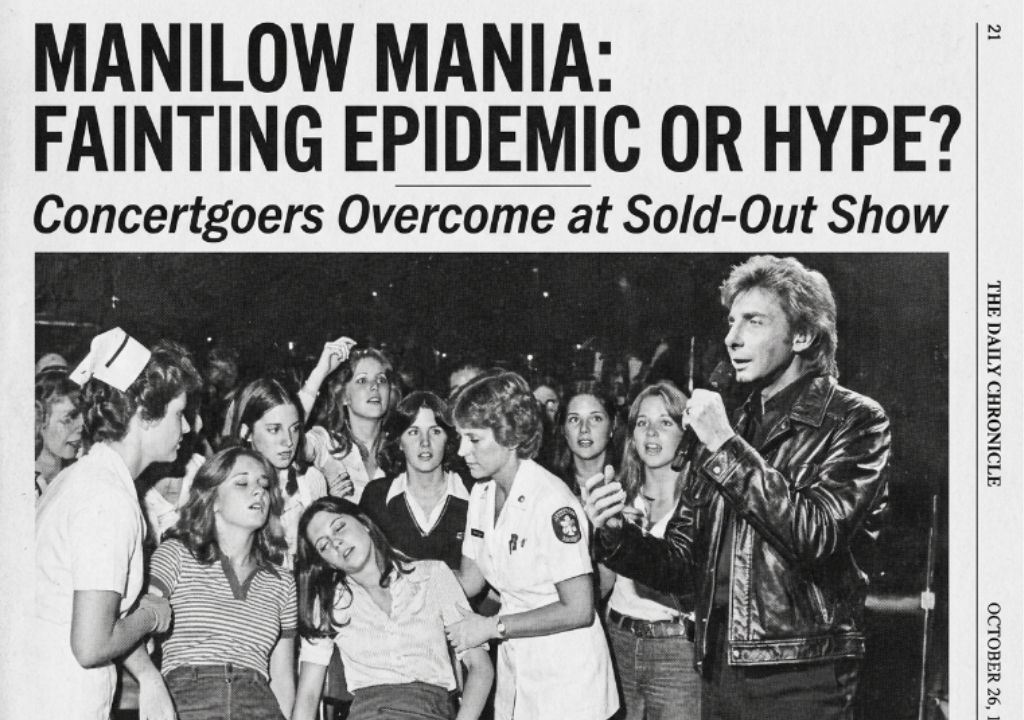
On a sweltering summer evening in 1977, medical personnel at a packed arena struggled to navigate a sea of overwhelmed spectators. As the opening chords of “Could It Be Magic” echoed through the rafters, a familiar ritual unfolded: young women collapsed into the arms of security guards, their exits documented by local news crews. The phenomenon, quickly dubbed “Manilowmania,” dominated entertainment columns, painting a picture of an artist whose soft-rock ballads possessed an almost supernatural, hypnotic power over audiences. Headlines across the United States claimed that the singer was causing a genuine public health hazard, with dozens of fans losing consciousness at every single tour stop. Yet beneath the sensationalized front-page stories lied a far more calculated reality, balancing the organic fervor of mid-century fandom with the machinery of modern public relations.
THE DETAILED STORY
To understand the myth, one must examine the intersection of 1970s arena infrastructure and calculated record label positioning. During this golden era, Barry Manilow was an absolute juggernaut for Arista Records, regularly grossing millions of dollars per tour. As his signature ballads conquered the Billboard charts, venues routinely oversold general admission spaces to maximize revenue. Investigative looks into archival tour logs reveal that the primary driver behind the fainting spells was entirely atmospheric. Venues during this period frequently suffered from inadequate ventilation, sub-standard air conditioning, and suffocating crowd densities. Combined with hours of standing in intense heat, hundreds of fans experienced standard vasovagal syncope—a common medical reaction to dehydration and physical exhaustion, rather than psychological possession.
However, industry executives quickly realized that a medical reality could be transformed into marketing gold. Instead of downplaying the incidents, promoters actively weaponized the narrative of fan hysteria to build an impenetrable aura of stardom. Press agents regularly ensured that photographers were stationed precisely where exhausted fans were being escorted out, providing local newspapers with sensational imagery. This calculated exposure successfully transformed ordinary heat exhaustion into a badge of cultural relevance.
The climax of this curated spectacle occurred nightly during his performance of “Can’t Smile Without You.” By establishing a tradition of pulling a single female fan onto the stage, the production team created a high-stakes environment where hyperventilation became an organic byproduct of extreme anticipation. Internal marketing strategies capitalized on these highly emotional interactions, ensuring that every swoon was framed as a testament to the artist’s irresistible charm. This mythic framework sustained sold-out residencies from New York to Las Vegas for decades. Ultimately, the legendary mass faintings were neither a complete fabrication nor a pure psychological anomaly; they were a textbook example of the entertainment industry taking a common environmental byproduct and beautifully spinning it into a multi-million-dollar myth that permanently cemented an icon’s legacy.