INTRODUCTION
In the late 1970s, the boundary between sacred melodies and secular rhythms was a strictly policed frontier. Traditional church institutions viewed the distortion of electric guitars with visceral suspicion, frequently labeling rock music as inherently corrupting. Yet, on February 13, 1979, during a blazing live broadcast on ITV’s Pop Gospel, Britain’s premier hitmaker stepped under the studio lights to shatter that paradigm. Backed by a driving rhythm section, he delivered a blistering rendition of a track that served as both an artistic blueprint and a spiritual manifesto. This performance was not merely a musical detour; it was a public declaration that the electric energy of modern pop belonged to the divine just as much as it did to the charts.
THE DETAILED STORY
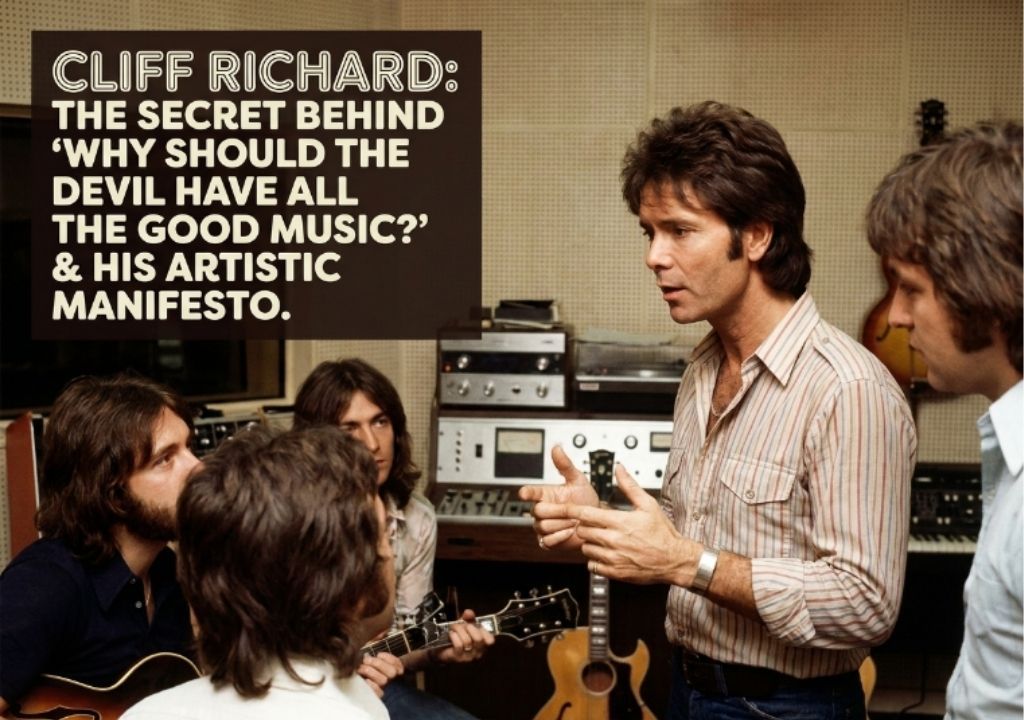
The composition at the heart of this sonic rebellion was “Why Should the Devil Have All the Good Music?”, a track originally penned by American Christian rock pioneer Larry Norman in 1972. While Norman’s original version carried a raw, underground edge, it took the institutional star power of Cliff Richard to elevate the concept into a mainstream phenomenon. He first recorded the anthem for his milestone 1977 gospel album, Small Corners, produced under his own artistic direction alongside engineered precision at Parlophone Records. The studio session brought together an elite group of musicians, including guitarist Terry Britten and bassist Alan Tarney, who crafted a polished, infectious pop-rock groove that defied the typically anemic production values of contemporary religious music.
By taking this audacious track to national television and performing it live during his celebrated London Palladium reunion concerts, the pop icon directly confronted his critics. The lyrics spoke explicitly to the hypocrisy of the era, declaring that traditional rules could not diminish a believer’s desire to dance. For an artist who had dominated the Official Singles Chart since the late 1950s, pivoting toward explicit gospel-rock was a massive commercial gamble.
The move paid off, solidifying his unique status as an entertainer who could seamlessly transition from standard secular romance to vibrant spiritual declarations without losing his massive fanbase. The track became a permanent cornerstone of his live legacy, reappearing in major retrospective events including his December 1995 performance with the All Souls Orchestra at the Royal Concert Hall in Nottingham. Through this definitive artistic statement, he proved that spiritual conviction did not require sonic compromise, forever changing how global audiences perceived the boundaries of popular music.