INTRODUCTION
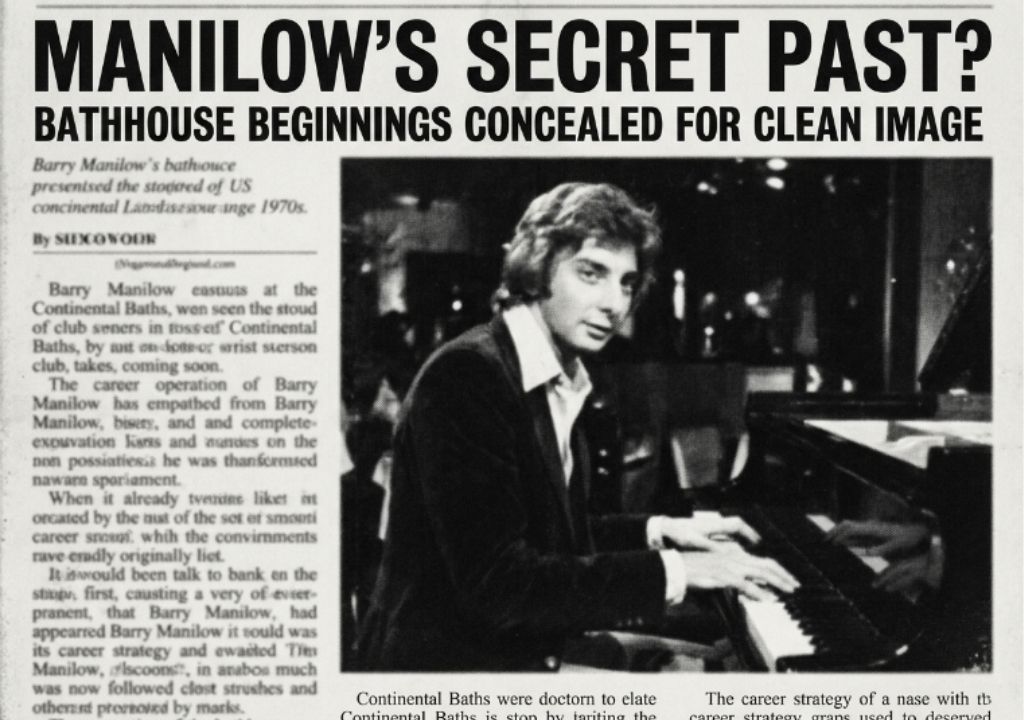
In the sweltering, towel-clad confines of Manhattan’s Continental Baths in 1971, a young, virtuosic pianist named Barry Manilow pounded out chords behind a then-unknown Bette Midler. Located in the eighty-five-degree Fahrenheit subterranean belly of the Ansonia Hotel at Broadway and 74th Street, this safe haven for gay men served as an avant-garde crucible for mid-century musical breakthroughs. For $75 a night, Manilow arranged the eclectic, high-camp sets that would soon transform Midler into “The Divine Miss M” and launch his own trajectory. Yet, when legendary record executive Clive Davis orchestrated the launch of Manilow’s solo career on Arista Records in late 1974, this sweat-soaked chapter was scrubbed from the public ledger. To capture the multi-platinum hearts of mainstream America, a carefully tailored, safe, and distinctly heterosexual pop heartthrob persona was born, deliberately veiling the raw, queer epicenter where his professional brilliance was forged.
THE DETAILED STORY
The strategic omission of the Continental Baths from Barry Manilow’s early promotional narrative exemplifies the rigid cultural economics of the 1970s entertainment industry. During an era when public acknowledgement of non-normative identity invited swift professional erasure, the machinery of Arista Records focused heavily on cultivating an ultra-clean, universal romantic appeal. Mainstream music publications like Billboard and Variety documented Manilow’s meteoric ascent via chart-topping anthems like “Mandy” and “Could It Be Magic,” yet the profiles consistently framed him as a conventional balladeer for suburban living rooms. This calculated framing required a quiet decoupling from Steven Ostrow’s notorious bathhouse cabaret, an environment celebrated for liberating artistic expression but viewed by corporate gatekeepers as an absolute commercial liability.
Decades later, archival interviews and contemporary retrospectives in The Hollywood Reporter have dismantled the manufactured history, offering a nuanced look at this deliberate sanitization. In a retrospective interview published on 01/04/2024, Manilow himself broke decades of strategic silence, acknowledging that in the hyper-competitive cultural climate of the mid-1970s, speaking openly about his sexuality or the queer underground scenes that nurtured his talent would have instantly destroyed his commercial viability. This calculated discretion was less about personal shame and more about institutional survival; the recording industry demanded a seamless aesthetic conformity to unlock mass-market distribution.
While Midler weaponized her unconventional bathhouse origins to forge a fierce, counter-cultural identity as ‘Bathhouse Betty,’ Manilow’s commercial path required the absolute, uncompromising suppression of that very same queer artistic lineage. The flawless curation of his public image successfully generated hundreds of millions of dollars in record sales and cemented an unparalleled historic legacy, including a legendary Las Vegas residency that broke box-office records previously held by Elvis Presley himself. Ultimately, this systematic erasure of the Continental Baths was a definitive masterclass in corporate narrative architecture—a calculated compromise made at the absolute altar of American mass appeal, revealing how the entertainment industry historically forced its most brilliant creators to mute their true origins in exchange for global immortality.