INTRODUCTION
Long before headlining sold-out arenas in Las Vegas or securing thirteen platinum records, a young, struggling Barry Manilow walked into a New York advertising agency in 1971 looking for a way to pay his rent. He was not a solo performer yet; he was a hired piano player and arranger working behind the scenes. When a commercial agency offered him a chance to write a melody for a Dodge commercial, he jumped at the opportunity. This unexpected phone call opened the floodgates to a highly prolific, yet deceptively modest, chapter in American pop music history. For the next few years, Manilow became the secret architect behind the catchy sonic backdrop of corporate America. He quietly compressed absolute raw human emotion and unforgettable hooks into strict fifteen-second television slots, transforming ordinary commercial products into cultural landmarks.
THE DETAILED STORY
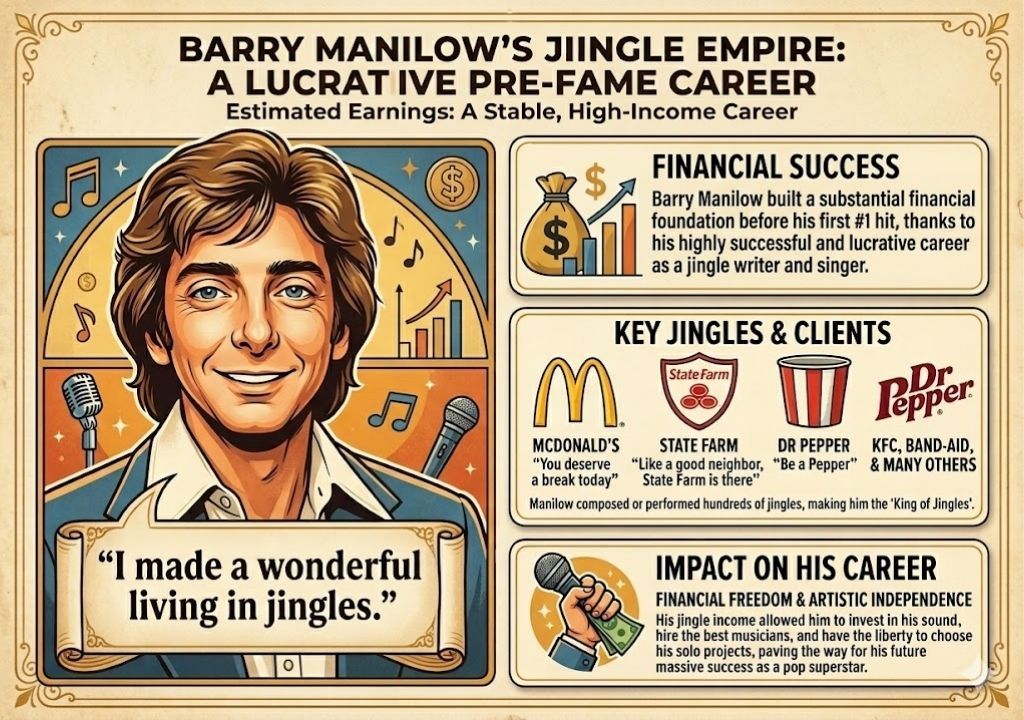
The economics of the 1970s advertising industry were brutal for creators, a reality Barry Manilow discovered firsthand. In the Madison Avenue ecosystem, jingle composers were typically subjected to flat-fee buyouts with absolutely zero long-term royalties. When Manilow penned the immortal nine-note melody for State Farm’s “Like a Good Neighbor” campaign in 1971, he received a single check for exactly $500 USD. Despite the track broadcasting continuously for more than fifty years, Manilow never collected a single cent in backend residuals for his compositional work. He later observed with wry amusement that while he received a modest one-time payment, the session vocalist who sang the line went on to purchase multiple luxury vehicles solely from her performance royalties. This stark economic disparity underscored the rigid, often unyielding corporate frameworks that thoroughly dominated twentieth-century broadcast media contracts.
However, Manilow’s financial landscape shifted drastically when he diversified his role. While songwriting yielded tiny flat fees, stepping into the recording booth as a background singer or voiceover performer triggered lucrative union protections. When he began singing his own arrangements for major corporations, the backend residuals finally generated substantial wealth. He lent his voice and pen to iconic campaigns including McDonald’s “You Deserve a Break Today,” Pepsi’s “Feelin’ Free,” and the legendary Band-Aid anthem, “I am stuck on Band-Aid, ’cause Band-Aid’s stuck on me.” The latter was written in a single pass alongside lyricist Donald B. Wood, eventually earning a prestigious Clio Award in 1976.
By the time he signed with Bell Records—later rebranded as Arista Records under Clive Davis—Manilow utilized these commercial hooks in his live concerts as a comedic segment called “A Very Strange Medley.” This lucrative advertising chapter concluded abruptly following the release of his sophomore studio album, Barry Manilow II, in October 1974. Fueled by the chart-topping success of the hit single “Mandy,” Manilow officially abandoned corporate commercial writing to become a global pop phenomenon, transforming a career built on five-hundred-dollar checks into an enduring multi-million-dollar entertainment empire.