INTRODUCTION
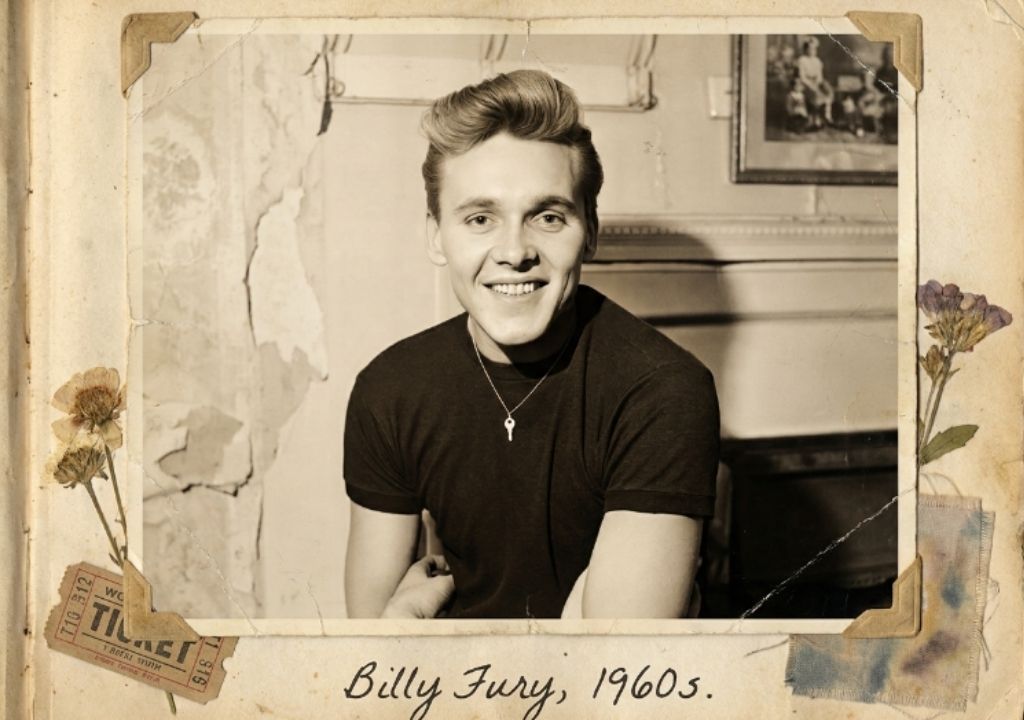
In the late autumn of 1967, inside the bustling studios of BBC Radio One’s Saturday Club, a remarkably gentle man stood before the microphone, radiating an immense politeness that completely stunned the production crew. This artist was Ronald Wycherley, known to millions of screaming fans across the globe by his electrifying stage moniker, Billy Fury. Decades after this precise era, a persistent, widely circulated myth emerged within contemporary pop history, claiming that the British rock-and-roll pioneer had been systematically boycotted by major broadcasters due to a series of radical, rebellious statements. Yet, an investigation into the archival record reveals a vastly different reality. Far from an ideological outlaw silenced by state gatekeepers, Fury’s late-sixties commercial trajectory was dictated not by political friction, but by a quiet, deeply dignified struggle against his own failing body and an unforgivingly transformed musical landscape.
THE DETAILED STORY
The historical record maintained by Billboard and Variety definitively dismantles any notion of an ideological radio boycott against Billy Fury during the late 1960s. In reality, Fury was legendary within the industry for his soft-spoken, incredibly courteous demeanor, routinely addressing interviewers and technical crews as “sir.” The only genuine institutional censorship he ever encountered occurred much earlier, on 10/17/1959, when theater managers at the Theatre Royal in Dublin abruptly dropped the curtain during his set due to his highly suggestive, Elvis-style hip-swiveling choreography. By the twilight of the decade, however, his absence from the upper echelons of the charts was caused by a profound convergence of deteriorating health and a seismic shift in youth culture.
Following his transition to EMI’s Parlophone label in December 1966, Fury continued to actively record live sessions for the BBC, a fact directly validated by surviving archival tapes from the Saturday Club program. The true limitation on his career was physiological. Having suffered from severe rheumatic fever as a child, his heart valves were critically damaged. The immense physical strain of touring in poorly ventilated venues, where summer heat often spiked past 95 Fahrenheit, induced profound exhaustion, forcing him to routinely cancel vital promotional appearances.
Concurrently, the British music scene was being completely re-architected by the psychedelic revolution spearheaded by The Beatles and progressive rock movements. Fury’s signature melancholic beat ballads suddenly found themselves displaced by a new sonic avant-garde. Facing an accumulation of unpaid back taxes totaling thousands of USD ($) dating back to his peak years, Fury gradually chose to step away from the relentless promotional apparatus. He retreated to a secluded farm to focus intensely on avian wildlife preservation. When he underwent his first major open-heart valve surgery on 10/14/1970, it became entirely clear to the industry that his retreat was a necessity for survival rather than a radio exile. Though prime-time retrospectives later aired across national ET/PT networks to celebrate his historic catalog, Fury’s late-sixties decline remains a deeply poignant narrative of physical vulnerability, completely decoupled from any manufactured tales of political rebellion.