INTRODUCTION
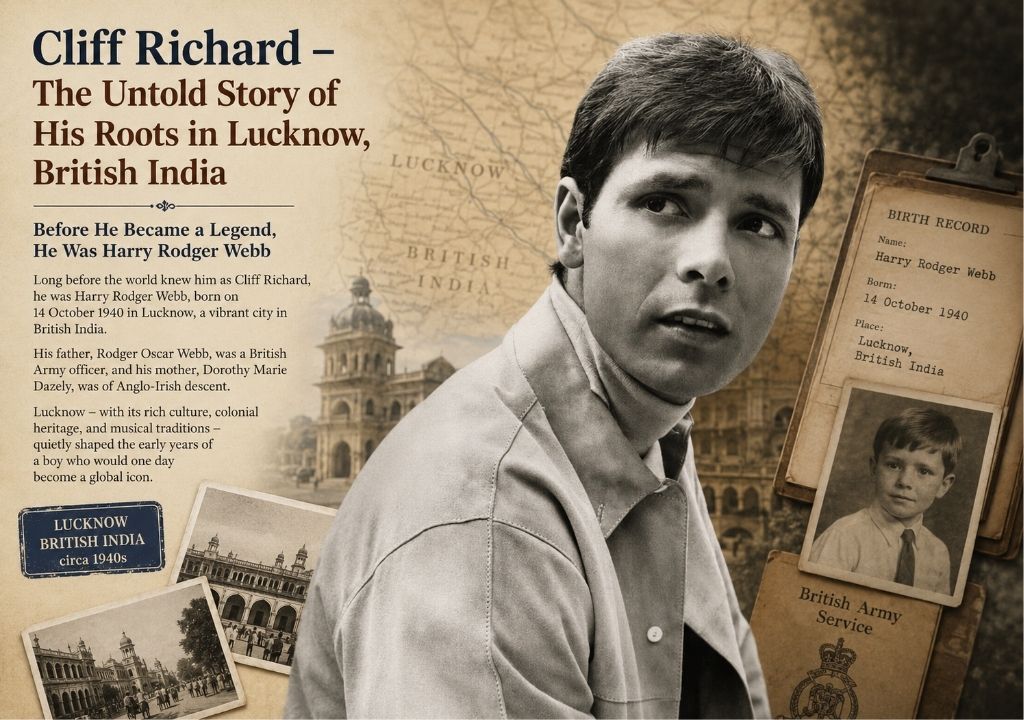
On 10/14/1940, inside King George’s Medical Hospital in Lucknow, British India, a boy named Harry Rodger Webb drew his first breath. The air outside was heavy with the autumn heat of the United Provinces, hovering near 90 degrees Fahrenheit, completely detached from the post-war austerity of London that would later define his career. Long before he transformed into Sir Cliff Richard, Britain’s premier rock-and-roll icon, this child lived a modest, sun-drenched existence in a colonial railway colony bungalow. His early world was defined by the clatter of the Indian Railways and the multicultural tapestry of a historic city, far removed from the neon marquees of the West End. This Eastern cradle did not merely shelter his infancy; it forged the core of a resilient, adaptable identity that would weather decades of global musical evolution.
THE DETAILED STORY
The narrative of British pop music frequently centers on post-war London or mid-century Liverpool, yet the foundational roots of its first genuine superstar trace back to the heart of Uttar Pradesh. Harry Rodger Webb’s father, Rodger Oscar Webb, worked a demanding job for the Indian Railways, a position that provided a respectable, upper-working-class lifestyle in British India. The Webb family navigated a vibrant, complex landscape where traditional British customs intersected daily with Indian culture. Young Harry spent his first seven years navigating the tree-lined avenues of Lucknow and later the bustling environs of Howrah near Calcutta, absorbing a rich auditory and visual environment long before ever hearing a guitar string snap.
This idyllic era abruptly shifted in August 1947 with the Partition of India. Facing an uncertain political climate, the Webb family made the monumental decision to relocate to the United Kingdom. In 1948, arriving aboard the SS Ranchi with barely a few pounds sterling to their name—amounting to less than $50 USD in their pockets—the family transitioned into a starkly different reality. They traded the spacious, sunlit landscapes of India for a cramped room in Carshalton, moving later to Waltham Cross. The shift was profound; the boy who had known the warmth of Lucknow was suddenly subjected to the gray, damp chill of a rebuilding Britain.
Yet, this dramatic displacement catalyzed his legendary ambition. Rebranding himself as Cliff Richard in the late 1950s, he channeled the inherent adaptability learned during his transnational childhood into a fearless stage persona. His cross-cultural genesis bestowed him with a distinct worldly perspective, allowing him to navigate the volatile entertainment industry with unparalleled grace. While contemporaries struggled with sudden fame, Richard maintained a grounded stability, a direct byproduct of a childhood spent bridging two vastly different worlds. His journey from a humble Lucknow bungalow to selling over 250 million records globally remains a testament to how an extraordinary Eastern beginning illuminated the path of a Western cultural phenomenon.